

Back to Blog
Chat to us
Got any questions? Curious to understand how introduce AI simply to manage your estate? Let's find some time to chat.
30 minute meeting with Nick

Closing the AI Performance Gap
AI adoption in property management has jumped from a fifth of firms to well over half in a single year, according to the latest industry research from Buildium. That's a genuinely brilliant number. But dig one layer deeper and the picture gets more interesting. Just 8% of firms have managed to fully automate a single workflow, and most current use is still centred on drafting property descriptions and tenant communications.
Zoom out to commercial real estate and the gap widens further. JLL's global survey of more than 1,500 industry leaders found that 92% of occupiers are now running AI pilots, up from just 5% three years ago. And yet only 5% report having achieved their programme goals.
That gap used to puzzle me. Now I think I know what's happening, and honestly, it's good news.
Most of what's been adopted so far is chatbots helping write reports, drafting emails, tidying up admin. Genuinely useful.
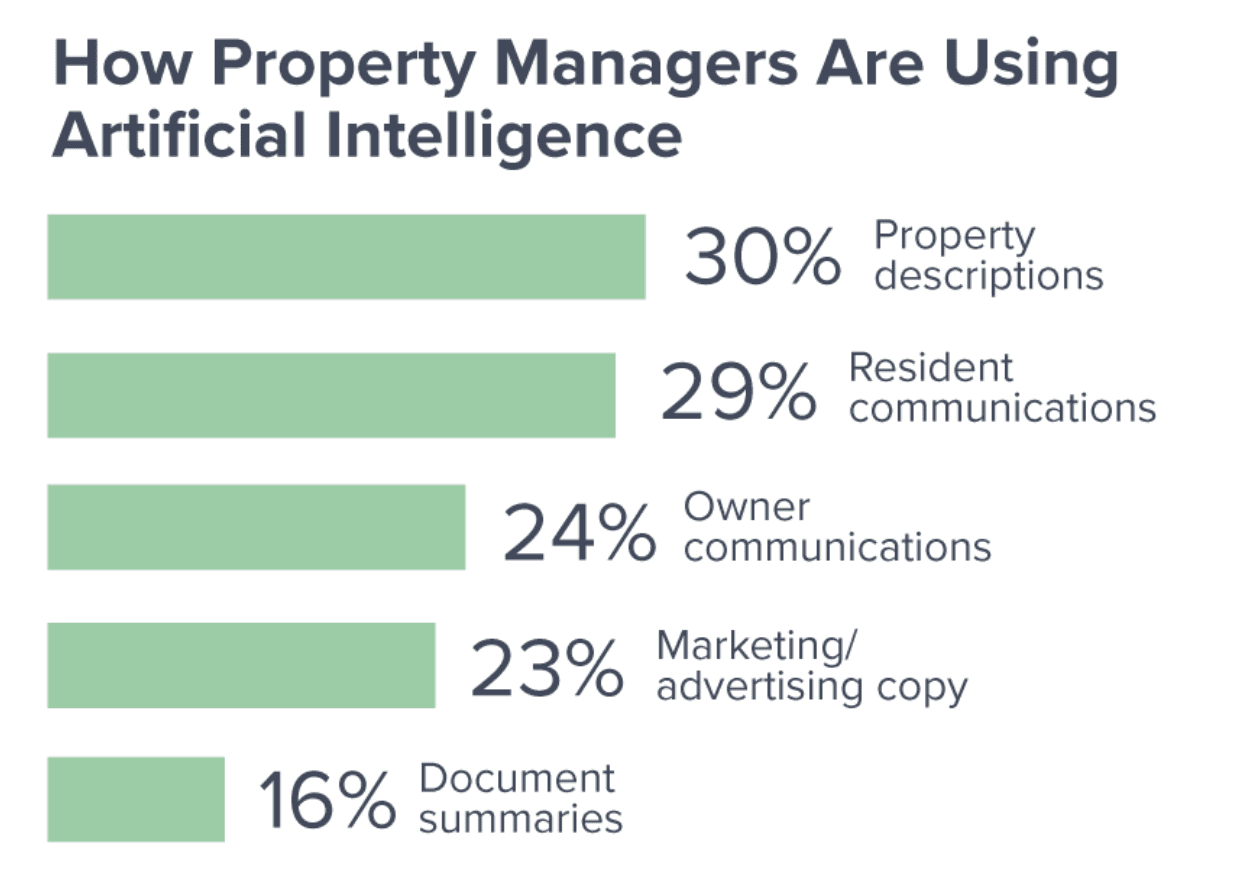
(Source: 2026 Property Management Industry Trends | Buildium Research)
The above is the shallow end of the pool. The real value, the kind that changes how a building runs, lives somewhere else entirely.
Take something as ordinary as heating a university campus. The old way, a facilities manager sets a schedule, checks consumption every so often, and nudges the set points when something looks off. It works, but it's reactive, and it's slow.
Now connect that same building's occupancy data, its consumption data and its schedule, and let it optimise live. No more periodic checking. No more lag between a room being empty and the heating knowing it. The manual review simply disappears, and the building starts running itself within sensible limits.
That's the leap from novelty to infrastructure, and it's a genuinely exciting one to watch happen. It's not flashy. Nobody's writing headlines about a heating schedule. But it's exactly the kind of low-risk, high-value work that proves AI's worth without anyone needing to bet the business on it.
My advice to any estate team feeling like their AI pilot has stalled: stop looking for the big dramatic rollout, and start looking at the process sitting right under your nose. Somewhere in your operation there's a version of that heating schedule, a manual check happening on a loop that doesn't need to be manual anymore. Find it, connect the data, and let it run itself.
That's where the real performance gap closes, quietly, building by building, and it's precisely the sort of change I think we'll all be talking about a lot more by this time next year.
Nick
Nick Tune
CEO OptimiseAI
Sources
Buildium, "2026 Property Management Industry Trends" — https://www.buildium.com/blog/2026-property-management-industry-trends/
JLL Newsroom, "Real estate's AI reality check," 28 October 2025 — https://www.jll.com/en-us/newsroom/real-estates-ai-reality-check-companies-piloting-only-achieved-all-ai-goals
Contact Us
Chat to us
Copyright ©
2026
optimise-ai.com
Back to Blog
Closing the AI Performance Gap
AI adoption in property management has jumped from a fifth of firms to well over half in a single year, according to the latest industry research from Buildium. That's a genuinely brilliant number. But dig one layer deeper and the picture gets more interesting. Just 8% of firms have managed to fully automate a single workflow, and most current use is still centred on drafting property descriptions and tenant communications.
Zoom out to commercial real estate and the gap widens further. JLL's global survey of more than 1,500 industry leaders found that 92% of occupiers are now running AI pilots, up from just 5% three years ago. And yet only 5% report having achieved their programme goals.
That gap used to puzzle me. Now I think I know what's happening, and honestly, it's good news.
Most of what's been adopted so far is chatbots helping write reports, drafting emails, tidying up admin. Genuinely useful.
(Source: 2026 Property Management Industry Trends | Buildium Research)
The above is the shallow end of the pool. The real value, the kind that changes how a building runs, lives somewhere else entirely.
Take something as ordinary as heating a university campus. The old way, a facilities manager sets a schedule, checks consumption every so often, and nudges the set points when something looks off. It works, but it's reactive, and it's slow.
Now connect that same building's occupancy data, its consumption data and its schedule, and let it optimise live. No more periodic checking. No more lag between a room being empty and the heating knowing it. The manual review simply disappears, and the building starts running itself within sensible limits.
That's the leap from novelty to infrastructure, and it's a genuinely exciting one to watch happen. It's not flashy. Nobody's writing headlines about a heating schedule. But it's exactly the kind of low-risk, high-value work that proves AI's worth without anyone needing to bet the business on it.
My advice to any estate team feeling like their AI pilot has stalled: stop looking for the big dramatic rollout, and start looking at the process sitting right under your nose. Somewhere in your operation there's a version of that heating schedule, a manual check happening on a loop that doesn't need to be manual anymore. Find it, connect the data, and let it run itself.
That's where the real performance gap closes, quietly, building by building, and it's precisely the sort of change I think we'll all be talking about a lot more by this time next year.
Nick
Nick Tune
CEO OptimiseAI
Sources
Buildium, "2026 Property Management Industry Trends" — https://www.buildium.com/blog/2026-property-management-industry-trends/
JLL Newsroom, "Real estate's AI reality check," 28 October 2025 — https://www.jll.com/en-us/newsroom/real-estates-ai-reality-check-companies-piloting-only-achieved-all-ai-goals
Contact Us
Back to Blog
Chat to us
Got any questions? Curious to understand how introduce AI simply to manage your estate? Let's find some time to chat.
30 minute meeting with Nick
Copyright ©
2026
optimise-ai.com
Back to Blog
Closing the AI Performance Gap
AI adoption in property management has jumped from a fifth of firms to well over half in a single year, according to the latest industry research from Buildium. That's a genuinely brilliant number. But dig one layer deeper and the picture gets more interesting. Just 8% of firms have managed to fully automate a single workflow, and most current use is still centred on drafting property descriptions and tenant communications.
Zoom out to commercial real estate and the gap widens further. JLL's global survey of more than 1,500 industry leaders found that 92% of occupiers are now running AI pilots, up from just 5% three years ago. And yet only 5% report having achieved their programme goals.
That gap used to puzzle me. Now I think I know what's happening, and honestly, it's good news.
Most of what's been adopted so far is chatbots helping write reports, drafting emails, tidying up admin. Genuinely useful.
(Source: 2026 Property Management Industry Trends | Buildium Research)
The above is the shallow end of the pool. The real value, the kind that changes how a building runs, lives somewhere else entirely.
Take something as ordinary as heating a university campus. The old way, a facilities manager sets a schedule, checks consumption every so often, and nudges the set points when something looks off. It works, but it's reactive, and it's slow.
Now connect that same building's occupancy data, its consumption data and its schedule, and let it optimise live. No more periodic checking. No more lag between a room being empty and the heating knowing it. The manual review simply disappears, and the building starts running itself within sensible limits.
That's the leap from novelty to infrastructure, and it's a genuinely exciting one to watch happen. It's not flashy. Nobody's writing headlines about a heating schedule. But it's exactly the kind of low-risk, high-value work that proves AI's worth without anyone needing to bet the business on it.
My advice to any estate team feeling like their AI pilot has stalled: stop looking for the big dramatic rollout, and start looking at the process sitting right under your nose. Somewhere in your operation there's a version of that heating schedule, a manual check happening on a loop that doesn't need to be manual anymore. Find it, connect the data, and let it run itself.
That's where the real performance gap closes, quietly, building by building, and it's precisely the sort of change I think we'll all be talking about a lot more by this time next year.
Nick
Nick Tune
CEO OptimiseAI
Sources
Buildium, "2026 Property Management Industry Trends" — https://www.buildium.com/blog/2026-property-management-industry-trends/
JLL Newsroom, "Real estate's AI reality check," 28 October 2025 — https://www.jll.com/en-us/newsroom/real-estates-ai-reality-check-companies-piloting-only-achieved-all-ai-goals
Contact Us
Back to Blog
Chat to us
Got any questions? Curious to understand how introduce AI simply to manage your estate? Let's find some time to chat.
30 minute meeting with Nick
Copyright ©
2026
optimise-ai.com