


The Funding Routes Worth Knowing, and Why Speed Wins
UK non-domestic buildings now sit inside a genuinely useful patchwork of funding for cooling and overheating measures: national heat pump grants, regional SME loans, sector-specific decarbonisation funds, local authority pots. The opportunity is real. So is the deadline.
Look down the list of live schemes and a pattern repeats. The Public Sector Low Carbon Heat Grant's entire 2026 window runs 10 August to 18 September, six weeks. The Green Heat Network Fund's current round closes 25 September. The Northern Ireland Sustainable Energy Programme allocates funds first come, first served, until the pot runs out. None of these wait for you to commission a survey.
Why Live Data
This is why live data isn't a nice-to-have for a funding application. It's often the only way to meet the requirements at all. Every scheme below asks for broadly the same evidence: a baseline of current energy use, the measures proposed and the problem each one solves, an installed cost backed by quotations, and the expected energy, carbon and cost savings with a payback figure. Commission that from scratch, building by building, with in-person surveys and consultant reports, and you're typically looking at weeks to months before you have a number you can put in an application. Most windows don't give you that long.
Live, continuously updated estate data closes that gap. When the baseline, the modelled savings and the indicative cost for every building are already sitting in one place, refreshed rather than commissioned, assembling an application becomes a matter of selecting the right building and the right measure for the scheme in front of you, not starting the evidence-gathering process from zero. That's the difference between missing a six-week window and beating it.
Funding routes worth knowing
The main UK non-domestic schemes relevant to overheating and cooling measures, current as of 4 August 2026. Availability and eligibility change quickly.
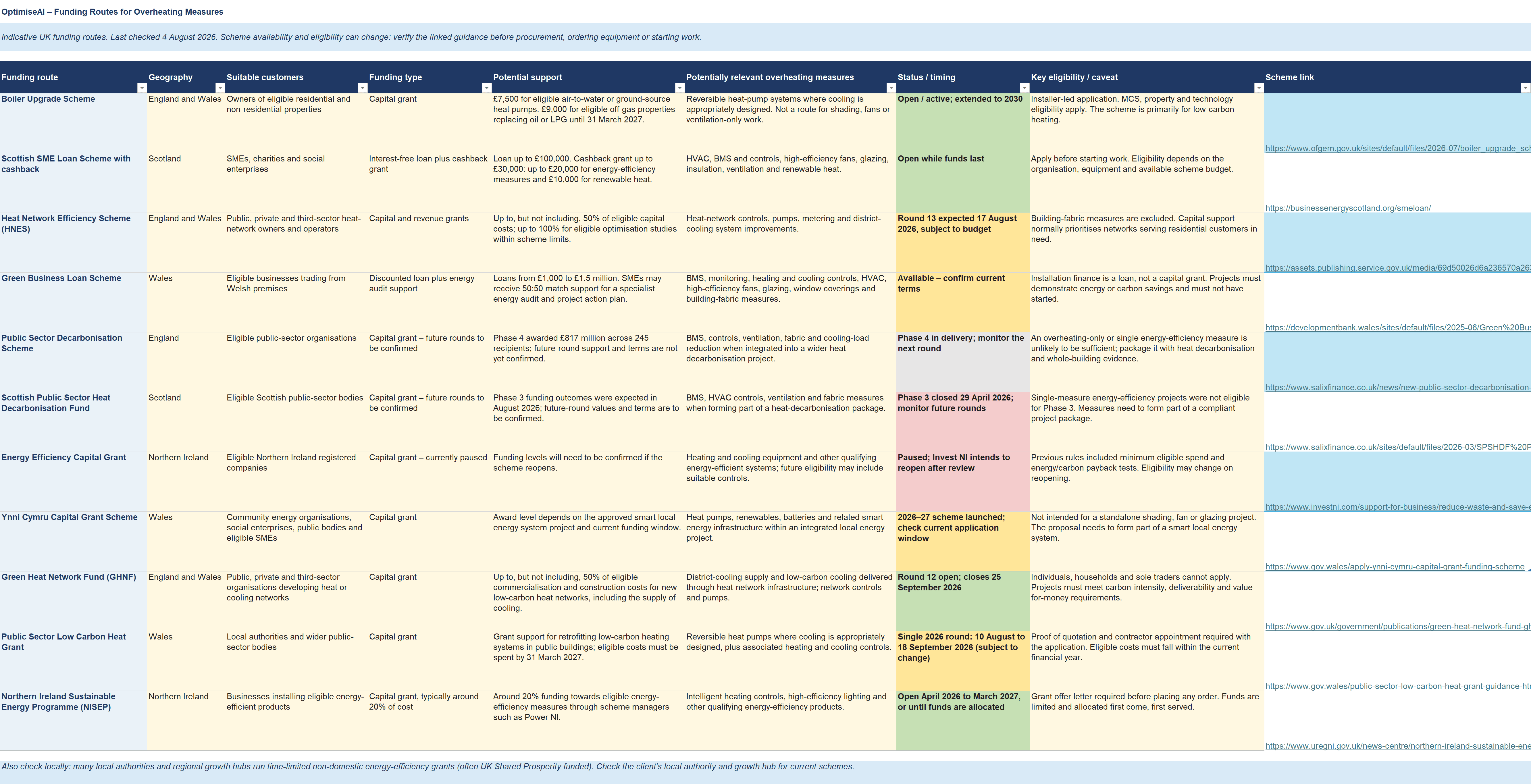
Download the full list here
What funders will typically ask for
Whichever scheme fits, the evidence pack looks similar. Having this ready before a window opens, rather than assembling it afterwards, is what turns an opportunity into a funded project:
Organisation type: private business, public body, charity, social enterprise, housing provider or community organisation
Location: UK nation and local authority area
Sector and size, including SME status
Ownership or remaining lease term on the building
Building type, floor area, occupancy and operating pattern
The proposed measures and the specific problem each one addresses
Baseline annual energy use and cost
Installed project cost, backed by supplier quotations
Expected annual energy, cost and carbon savings, plus simple payback
Occupant benefits: comfort, health, productivity, air quality, service continuity
Available match funding, and any previous public subsidy received
Confirmation that no order has been placed or work started
We built Predict For Real Time Data
Predict keeps your evidence live for every building in your estate: a continuously updated baseline, a ranked list of the measures that suit each asset, and the modelled cost, saving and payback figures funders ask for. When a grant window opens, or a first-come-first-served pot goes live, you're ready to make the application. We built Predict to enable this and validate the project reciveing the funding.
Find out more about Predict
Not sure which measures your estate should prioritise first? Our companion article ranks the ten highest-return overheating fixes available right now, several needing very little capital.
British summers have changed, and so has the funding landscape around them. The estates that benefit are the ones ready to move the moment the window opens.
OptimiseAI's Rapid Estate Review gives you a fast, evidence-based snapshot of overheating risk and cooling readiness across your entire portfolio. Pair it with our Costing Plan and you'll have a prioritised, funding-ready action plan: costed, evidenced, and ready to submit.
UK Schemes
Boiler Upgrade Scheme (England and Wales · Open and active, extended to 2030)
Who it's for: Owners of eligible residential and non-residential properties
What's on offer: £7,500 for eligible air-to-water or ground-source heat pumps; £9,000 for eligible off-gas properties replacing oil or LPG, until 31 March 2027
Watch for: Installer-led application. Primarily a low-carbon heating scheme: covers reversible heat pumps where cooling is properly designed in, not shading, fans or ventilation-only projects.
Scottish SME Loan Scheme with cashback (Scotland · Open while funds last)
Who it's for: SMEs, charities and social enterprises
What's on offer: Interest-free loan up to £100,000, plus a cashback grant up to £30,000 (up to £20,000 for energy efficiency, £10,000 for renewable heat)
Watch for: Apply before starting work. Covers HVAC, BMS and controls, high-efficiency fans, glazing, insulation, ventilation and renewable heat.
Heat Network Efficiency Scheme (HNES) (England and Wales · Round 13 expected 17 August 2026, subject to budget)
Who it's for: Public, private and third-sector heat-network owners and operators
What's on offer: Up to 50% of eligible capital costs; up to 100% for eligible optimisation studies within scheme limits
Watch for: Building-fabric measures are excluded. Capital support usually prioritises networks serving residential customers in need.
Green Business Loan Scheme (Wales · Available, confirm current terms)
Who it's for: Eligible businesses trading from Welsh premises
What's on offer: Discounted loans from £1,000 to £1.5 million; SMEs may get 50:50 match support for a specialist energy audit and action plan
Watch for: A loan, not a capital grant. Projects must demonstrate energy or carbon savings and must not have already started.
Public Sector Decarbonisation Scheme (England · Phase 4 in delivery, monitor the next round)
Who it's for: Eligible public-sector organisations
What's on offer: Phase 4 awarded £817 million across 245 recipients; future-round terms not yet confirmed
Watch for: An overheating-only project is unlikely to qualify alone: package it with wider heat decarbonisation and whole-building evidence.
Scottish Public Sector Heat Decarbonisation Fund (Scotland · Phase 3 closed 29 April 2026, monitor future rounds)
Who it's for: Eligible Scottish public-sector bodies
What's on offer: Phase 3 outcomes expected August 2026; future-round values to be confirmed
Watch for: Single-measure projects were not eligible for Phase 3. Measures need to sit within a compliant project package.
Energy Efficiency Capital Grant (Northern Ireland · Paused, Invest NI intends to reopen after review)
Who it's for: Eligible Northern Ireland registered companies
What's on offer: Currently paused; funding levels to be confirmed if it reopens
Watch for: Previous rounds included a minimum eligible spend and energy/carbon payback tests. Eligibility may change on reopening.
Ynni Cymru Capital Grant Scheme (Wales · 2026–27 scheme launched, check current application window)
Who it's for: Community-energy organisations, social enterprises, public bodies and eligible SMEs
What's on offer: Award level depends on the approved smart local energy system project and current funding window
Watch for: Not for a standalone shading, fan or glazing project: the proposal needs to sit within a smart local energy system.
Green Heat Network Fund (GHNF) (England and Wales · Round 12 open, closes 25 September 2026)
Who it's for: Public, private and third-sector organisations developing heat or cooling networks
What's on offer: Up to 50% of eligible commercialisation and construction costs for new low-carbon heat networks, including cooling supply
Watch for: Individuals, households and sole traders cannot apply. Projects must meet carbon-intensity, deliverability and value-for-money tests.
Public Sector Low Carbon Heat Grant (Wales · Single 2026 round: 10 August–18 September 2026, subject to change)
Who it's for: Local authorities and wider public-sector bodies
What's on offer: Grant support for retrofitting low-carbon heating systems in public buildings; eligible costs must be spent by 31 March 2027
Watch for: Proof of quotation and contractor appointment required with the application. Costs must fall within the current financial year.
Northern Ireland Sustainable Energy Programme (NISEP) (Northern Ireland · Open April 2026 to March 2027, or until funds are allocated)
Who it's for: Businesses installing eligible energy-efficient products
What's on offer: Typically around 20% of eligible energy-efficiency measure costs
Watch for: A grant offer letter is required before placing any order. Funds are limited and allocated first come, first served.
Many local authorities and regional growth hubs also run time-limited non-domestic energy-efficiency grants, often UK Shared Prosperity Fund backed. Worth a check alongside the national schemes above.
Sources
Boiler Upgrade Scheme: https://www.ofgem.gov.uk/sites/default/files/2026-07/boiler_upgrade_scheme_guidance_for_installers_v5.1_20260630135616-20260701135531.pdf
Scottish SME Loan Scheme with cashback: https://businessenergyscotland.org/smeloan/
Heat Network Efficiency Scheme (HNES): https://assets.publishing.service.gov.uk/media/69d50026d6a236570a263e81/HNES-guidance-for-applicants-round-12.pdf
Green Business Loan Scheme: https://developmentbank.wales/sites/default/files/2025-06/Green%20Business%20Loan%20Fund%20campaign_guide_Eng_final%20%281%29.pdf
Public Sector Decarbonisation Scheme: https://www.salixfinance.co.uk/news/new-public-sector-decarbonisation-scheme-data-highlights-scale-delivery-across-public-sector
Scottish Public Sector Heat Decarbonisation Fund: https://www.salixfinance.co.uk/sites/default/files/2026-03/SPSHDF%20Phase%203%20Guidance%20Notes.pdf
Energy Efficiency Capital Grant: https://www.investni.com/support-for-business/reduce-waste-and-save-energy/energy-efficiency-capital-grant
Ynni Cymru Capital Grant Scheme: https://www.gov.wales/apply-ynni-cymru-capital-grant-funding-scheme
Green Heat Network Fund (GHNF): https://www.gov.uk/government/publications/green-heat-network-fund-ghnf-guidance-on-how-to-apply
Public Sector Low Carbon Heat Grant: https://www.gov.wales/public-sector-low-carbon-heat-grant-guidance-html
Northern Ireland Sustainable Energy Programme (NISEP): https://www.uregni.gov.uk/news-centre/northern-ireland-sustainable-energy-programme-list-schemes-20262027-published
OptimiseAI internal funding analysis: scheme details last checked 4 August 2026 and subject to change; always confirm against current scheme guidance before applying.
Chat to us
Copyright ©
2026
optimise-ai.com
Back to Blog
The Funding Routes Worth Knowing, and Why Speed Wins
UK non-domestic buildings now sit inside a genuinely useful patchwork of funding for cooling and overheating measures: national heat pump grants, regional SME loans, sector-specific decarbonisation funds, local authority pots. The opportunity is real. So is the deadline.
Look down the list of live schemes and a pattern repeats. The Public Sector Low Carbon Heat Grant's entire 2026 window runs 10 August to 18 September, six weeks. The Green Heat Network Fund's current round closes 25 September. The Northern Ireland Sustainable Energy Programme allocates funds first come, first served, until the pot runs out. None of these wait for you to commission a survey.
Why Live Data
This is why live data isn't a nice-to-have for a funding application. It's often the only way to meet the requirements at all. Every scheme below asks for broadly the same evidence: a baseline of current energy use, the measures proposed and the problem each one solves, an installed cost backed by quotations, and the expected energy, carbon and cost savings with a payback figure. Commission that from scratch, building by building, with in-person surveys and consultant reports, and you're typically looking at weeks to months before you have a number you can put in an application. Most windows don't give you that long.
Live, continuously updated estate data closes that gap. When the baseline, the modelled savings and the indicative cost for every building are already sitting in one place, refreshed rather than commissioned, assembling an application becomes a matter of selecting the right building and the right measure for the scheme in front of you, not starting the evidence-gathering process from zero. That's the difference between missing a six-week window and beating it.
Funding routes worth knowing
The main UK non-domestic schemes relevant to overheating and cooling measures, current as of 4 August 2026. Availability and eligibility change quickly.
Download the full list here
What funders will typically ask for
Whichever scheme fits, the evidence pack looks similar. Having this ready before a window opens, rather than assembling it afterwards, is what turns an opportunity into a funded project:
Organisation type: private business, public body, charity, social enterprise, housing provider or community organisation
Location: UK nation and local authority area
Sector and size, including SME status
Ownership or remaining lease term on the building
Building type, floor area, occupancy and operating pattern
The proposed measures and the specific problem each one addresses
Baseline annual energy use and cost
Installed project cost, backed by supplier quotations
Expected annual energy, cost and carbon savings, plus simple payback
Occupant benefits: comfort, health, productivity, air quality, service continuity
Available match funding, and any previous public subsidy received
Confirmation that no order has been placed or work started
We built Predict For Real Time Data
Predict keeps your evidence live for every building in your estate: a continuously updated baseline, a ranked list of the measures that suit each asset, and the modelled cost, saving and payback figures funders ask for. When a grant window opens, or a first-come-first-served pot goes live, you're ready to make the application. We built Predict to enable this and validate the project reciveing the funding.
Find out more about Predict
Not sure which measures your estate should prioritise first? Our companion article ranks the ten highest-return overheating fixes available right now, several needing very little capital.
British summers have changed, and so has the funding landscape around them. The estates that benefit are the ones ready to move the moment the window opens.
OptimiseAI's Rapid Estate Review gives you a fast, evidence-based snapshot of overheating risk and cooling readiness across your entire portfolio. Pair it with our Costing Plan and you'll have a prioritised, funding-ready action plan: costed, evidenced, and ready to submit.
UK Schemes
Boiler Upgrade Scheme (England and Wales · Open and active, extended to 2030)
Who it's for: Owners of eligible residential and non-residential properties
What's on offer: £7,500 for eligible air-to-water or ground-source heat pumps; £9,000 for eligible off-gas properties replacing oil or LPG, until 31 March 2027
Watch for: Installer-led application. Primarily a low-carbon heating scheme: covers reversible heat pumps where cooling is properly designed in, not shading, fans or ventilation-only projects.
Scottish SME Loan Scheme with cashback (Scotland · Open while funds last)
Who it's for: SMEs, charities and social enterprises
What's on offer: Interest-free loan up to £100,000, plus a cashback grant up to £30,000 (up to £20,000 for energy efficiency, £10,000 for renewable heat)
Watch for: Apply before starting work. Covers HVAC, BMS and controls, high-efficiency fans, glazing, insulation, ventilation and renewable heat.
Heat Network Efficiency Scheme (HNES) (England and Wales · Round 13 expected 17 August 2026, subject to budget)
Who it's for: Public, private and third-sector heat-network owners and operators
What's on offer: Up to 50% of eligible capital costs; up to 100% for eligible optimisation studies within scheme limits
Watch for: Building-fabric measures are excluded. Capital support usually prioritises networks serving residential customers in need.
Green Business Loan Scheme (Wales · Available, confirm current terms)
Who it's for: Eligible businesses trading from Welsh premises
What's on offer: Discounted loans from £1,000 to £1.5 million; SMEs may get 50:50 match support for a specialist energy audit and action plan
Watch for: A loan, not a capital grant. Projects must demonstrate energy or carbon savings and must not have already started.
Public Sector Decarbonisation Scheme (England · Phase 4 in delivery, monitor the next round)
Who it's for: Eligible public-sector organisations
What's on offer: Phase 4 awarded £817 million across 245 recipients; future-round terms not yet confirmed
Watch for: An overheating-only project is unlikely to qualify alone: package it with wider heat decarbonisation and whole-building evidence.
Scottish Public Sector Heat Decarbonisation Fund (Scotland · Phase 3 closed 29 April 2026, monitor future rounds)
Who it's for: Eligible Scottish public-sector bodies
What's on offer: Phase 3 outcomes expected August 2026; future-round values to be confirmed
Watch for: Single-measure projects were not eligible for Phase 3. Measures need to sit within a compliant project package.
Energy Efficiency Capital Grant (Northern Ireland · Paused, Invest NI intends to reopen after review)
Who it's for: Eligible Northern Ireland registered companies
What's on offer: Currently paused; funding levels to be confirmed if it reopens
Watch for: Previous rounds included a minimum eligible spend and energy/carbon payback tests. Eligibility may change on reopening.
Ynni Cymru Capital Grant Scheme (Wales · 2026–27 scheme launched, check current application window)
Who it's for: Community-energy organisations, social enterprises, public bodies and eligible SMEs
What's on offer: Award level depends on the approved smart local energy system project and current funding window
Watch for: Not for a standalone shading, fan or glazing project: the proposal needs to sit within a smart local energy system.
Green Heat Network Fund (GHNF) (England and Wales · Round 12 open, closes 25 September 2026)
Who it's for: Public, private and third-sector organisations developing heat or cooling networks
What's on offer: Up to 50% of eligible commercialisation and construction costs for new low-carbon heat networks, including cooling supply
Watch for: Individuals, households and sole traders cannot apply. Projects must meet carbon-intensity, deliverability and value-for-money tests.
Public Sector Low Carbon Heat Grant (Wales · Single 2026 round: 10 August–18 September 2026, subject to change)
Who it's for: Local authorities and wider public-sector bodies
What's on offer: Grant support for retrofitting low-carbon heating systems in public buildings; eligible costs must be spent by 31 March 2027
Watch for: Proof of quotation and contractor appointment required with the application. Costs must fall within the current financial year.
Northern Ireland Sustainable Energy Programme (NISEP) (Northern Ireland · Open April 2026 to March 2027, or until funds are allocated)
Who it's for: Businesses installing eligible energy-efficient products
What's on offer: Typically around 20% of eligible energy-efficiency measure costs
Watch for: A grant offer letter is required before placing any order. Funds are limited and allocated first come, first served.
Many local authorities and regional growth hubs also run time-limited non-domestic energy-efficiency grants, often UK Shared Prosperity Fund backed. Worth a check alongside the national schemes above.
Sources
Boiler Upgrade Scheme: https://www.ofgem.gov.uk/sites/default/files/2026-07/boiler_upgrade_scheme_guidance_for_installers_v5.1_20260630135616-20260701135531.pdf
Scottish SME Loan Scheme with cashback: https://businessenergyscotland.org/smeloan/
Heat Network Efficiency Scheme (HNES): https://assets.publishing.service.gov.uk/media/69d50026d6a236570a263e81/HNES-guidance-for-applicants-round-12.pdf
Green Business Loan Scheme: https://developmentbank.wales/sites/default/files/2025-06/Green%20Business%20Loan%20Fund%20campaign_guide_Eng_final%20%281%29.pdf
Public Sector Decarbonisation Scheme: https://www.salixfinance.co.uk/news/new-public-sector-decarbonisation-scheme-data-highlights-scale-delivery-across-public-sector
Scottish Public Sector Heat Decarbonisation Fund: https://www.salixfinance.co.uk/sites/default/files/2026-03/SPSHDF%20Phase%203%20Guidance%20Notes.pdf
Energy Efficiency Capital Grant: https://www.investni.com/support-for-business/reduce-waste-and-save-energy/energy-efficiency-capital-grant
Ynni Cymru Capital Grant Scheme: https://www.gov.wales/apply-ynni-cymru-capital-grant-funding-scheme
Green Heat Network Fund (GHNF): https://www.gov.uk/government/publications/green-heat-network-fund-ghnf-guidance-on-how-to-apply
Public Sector Low Carbon Heat Grant: https://www.gov.wales/public-sector-low-carbon-heat-grant-guidance-html
Northern Ireland Sustainable Energy Programme (NISEP): https://www.uregni.gov.uk/news-centre/northern-ireland-sustainable-energy-programme-list-schemes-20262027-published
OptimiseAI internal funding analysis: scheme details last checked 4 August 2026 and subject to change; always confirm against current scheme guidance before applying.
Copyright ©
2026
optimise-ai.com
Back to Blog
The Funding Routes Worth Knowing, and Why Speed Wins
UK non-domestic buildings now sit inside a genuinely useful patchwork of funding for cooling and overheating measures: national heat pump grants, regional SME loans, sector-specific decarbonisation funds, local authority pots. The opportunity is real. So is the deadline.
Look down the list of live schemes and a pattern repeats. The Public Sector Low Carbon Heat Grant's entire 2026 window runs 10 August to 18 September, six weeks. The Green Heat Network Fund's current round closes 25 September. The Northern Ireland Sustainable Energy Programme allocates funds first come, first served, until the pot runs out. None of these wait for you to commission a survey.
Why Live Data
This is why live data isn't a nice-to-have for a funding application. It's often the only way to meet the requirements at all. Every scheme below asks for broadly the same evidence: a baseline of current energy use, the measures proposed and the problem each one solves, an installed cost backed by quotations, and the expected energy, carbon and cost savings with a payback figure. Commission that from scratch, building by building, with in-person surveys and consultant reports, and you're typically looking at weeks to months before you have a number you can put in an application. Most windows don't give you that long.
Live, continuously updated estate data closes that gap. When the baseline, the modelled savings and the indicative cost for every building are already sitting in one place, refreshed rather than commissioned, assembling an application becomes a matter of selecting the right building and the right measure for the scheme in front of you, not starting the evidence-gathering process from zero. That's the difference between missing a six-week window and beating it.
Funding routes worth knowing
The main UK non-domestic schemes relevant to overheating and cooling measures, current as of 4 August 2026. Availability and eligibility change quickly.
Download the full list here
What funders will typically ask for
Whichever scheme fits, the evidence pack looks similar. Having this ready before a window opens, rather than assembling it afterwards, is what turns an opportunity into a funded project:
Organisation type: private business, public body, charity, social enterprise, housing provider or community organisation
Location: UK nation and local authority area
Sector and size, including SME status
Ownership or remaining lease term on the building
Building type, floor area, occupancy and operating pattern
The proposed measures and the specific problem each one addresses
Baseline annual energy use and cost
Installed project cost, backed by supplier quotations
Expected annual energy, cost and carbon savings, plus simple payback
Occupant benefits: comfort, health, productivity, air quality, service continuity
Available match funding, and any previous public subsidy received
Confirmation that no order has been placed or work started
We built Predict For Real Time Data
Predict keeps your evidence live for every building in your estate: a continuously updated baseline, a ranked list of the measures that suit each asset, and the modelled cost, saving and payback figures funders ask for. When a grant window opens, or a first-come-first-served pot goes live, you're ready to make the application. We built Predict to enable this and validate the project reciveing the funding.
Find out more about Predict
Not sure which measures your estate should prioritise first? Our companion article ranks the ten highest-return overheating fixes available right now, several needing very little capital.
British summers have changed, and so has the funding landscape around them. The estates that benefit are the ones ready to move the moment the window opens.
OptimiseAI's Rapid Estate Review gives you a fast, evidence-based snapshot of overheating risk and cooling readiness across your entire portfolio. Pair it with our Costing Plan and you'll have a prioritised, funding-ready action plan: costed, evidenced, and ready to submit.
UK Schemes
Boiler Upgrade Scheme (England and Wales · Open and active, extended to 2030)
Who it's for: Owners of eligible residential and non-residential properties
What's on offer: £7,500 for eligible air-to-water or ground-source heat pumps; £9,000 for eligible off-gas properties replacing oil or LPG, until 31 March 2027
Watch for: Installer-led application. Primarily a low-carbon heating scheme: covers reversible heat pumps where cooling is properly designed in, not shading, fans or ventilation-only projects.
Scottish SME Loan Scheme with cashback (Scotland · Open while funds last)
Who it's for: SMEs, charities and social enterprises
What's on offer: Interest-free loan up to £100,000, plus a cashback grant up to £30,000 (up to £20,000 for energy efficiency, £10,000 for renewable heat)
Watch for: Apply before starting work. Covers HVAC, BMS and controls, high-efficiency fans, glazing, insulation, ventilation and renewable heat.
Heat Network Efficiency Scheme (HNES) (England and Wales · Round 13 expected 17 August 2026, subject to budget)
Who it's for: Public, private and third-sector heat-network owners and operators
What's on offer: Up to 50% of eligible capital costs; up to 100% for eligible optimisation studies within scheme limits
Watch for: Building-fabric measures are excluded. Capital support usually prioritises networks serving residential customers in need.
Green Business Loan Scheme (Wales · Available, confirm current terms)
Who it's for: Eligible businesses trading from Welsh premises
What's on offer: Discounted loans from £1,000 to £1.5 million; SMEs may get 50:50 match support for a specialist energy audit and action plan
Watch for: A loan, not a capital grant. Projects must demonstrate energy or carbon savings and must not have already started.
Public Sector Decarbonisation Scheme (England · Phase 4 in delivery, monitor the next round)
Who it's for: Eligible public-sector organisations
What's on offer: Phase 4 awarded £817 million across 245 recipients; future-round terms not yet confirmed
Watch for: An overheating-only project is unlikely to qualify alone: package it with wider heat decarbonisation and whole-building evidence.
Scottish Public Sector Heat Decarbonisation Fund (Scotland · Phase 3 closed 29 April 2026, monitor future rounds)
Who it's for: Eligible Scottish public-sector bodies
What's on offer: Phase 3 outcomes expected August 2026; future-round values to be confirmed
Watch for: Single-measure projects were not eligible for Phase 3. Measures need to sit within a compliant project package.
Energy Efficiency Capital Grant (Northern Ireland · Paused, Invest NI intends to reopen after review)
Who it's for: Eligible Northern Ireland registered companies
What's on offer: Currently paused; funding levels to be confirmed if it reopens
Watch for: Previous rounds included a minimum eligible spend and energy/carbon payback tests. Eligibility may change on reopening.
Ynni Cymru Capital Grant Scheme (Wales · 2026–27 scheme launched, check current application window)
Who it's for: Community-energy organisations, social enterprises, public bodies and eligible SMEs
What's on offer: Award level depends on the approved smart local energy system project and current funding window
Watch for: Not for a standalone shading, fan or glazing project: the proposal needs to sit within a smart local energy system.
Green Heat Network Fund (GHNF) (England and Wales · Round 12 open, closes 25 September 2026)
Who it's for: Public, private and third-sector organisations developing heat or cooling networks
What's on offer: Up to 50% of eligible commercialisation and construction costs for new low-carbon heat networks, including cooling supply
Watch for: Individuals, households and sole traders cannot apply. Projects must meet carbon-intensity, deliverability and value-for-money tests.
Public Sector Low Carbon Heat Grant (Wales · Single 2026 round: 10 August–18 September 2026, subject to change)
Who it's for: Local authorities and wider public-sector bodies
What's on offer: Grant support for retrofitting low-carbon heating systems in public buildings; eligible costs must be spent by 31 March 2027
Watch for: Proof of quotation and contractor appointment required with the application. Costs must fall within the current financial year.
Northern Ireland Sustainable Energy Programme (NISEP) (Northern Ireland · Open April 2026 to March 2027, or until funds are allocated)
Who it's for: Businesses installing eligible energy-efficient products
What's on offer: Typically around 20% of eligible energy-efficiency measure costs
Watch for: A grant offer letter is required before placing any order. Funds are limited and allocated first come, first served.
Many local authorities and regional growth hubs also run time-limited non-domestic energy-efficiency grants, often UK Shared Prosperity Fund backed. Worth a check alongside the national schemes above.
Sources
Boiler Upgrade Scheme: https://www.ofgem.gov.uk/sites/default/files/2026-07/boiler_upgrade_scheme_guidance_for_installers_v5.1_20260630135616-20260701135531.pdf
Scottish SME Loan Scheme with cashback: https://businessenergyscotland.org/smeloan/
Heat Network Efficiency Scheme (HNES): https://assets.publishing.service.gov.uk/media/69d50026d6a236570a263e81/HNES-guidance-for-applicants-round-12.pdf
Green Business Loan Scheme: https://developmentbank.wales/sites/default/files/2025-06/Green%20Business%20Loan%20Fund%20campaign_guide_Eng_final%20%281%29.pdf
Public Sector Decarbonisation Scheme: https://www.salixfinance.co.uk/news/new-public-sector-decarbonisation-scheme-data-highlights-scale-delivery-across-public-sector
Scottish Public Sector Heat Decarbonisation Fund: https://www.salixfinance.co.uk/sites/default/files/2026-03/SPSHDF%20Phase%203%20Guidance%20Notes.pdf
Energy Efficiency Capital Grant: https://www.investni.com/support-for-business/reduce-waste-and-save-energy/energy-efficiency-capital-grant
Ynni Cymru Capital Grant Scheme: https://www.gov.wales/apply-ynni-cymru-capital-grant-funding-scheme
Green Heat Network Fund (GHNF): https://www.gov.uk/government/publications/green-heat-network-fund-ghnf-guidance-on-how-to-apply
Public Sector Low Carbon Heat Grant: https://www.gov.wales/public-sector-low-carbon-heat-grant-guidance-html
Northern Ireland Sustainable Energy Programme (NISEP): https://www.uregni.gov.uk/news-centre/northern-ireland-sustainable-energy-programme-list-schemes-20262027-published
OptimiseAI internal funding analysis: scheme details last checked 4 August 2026 and subject to change; always confirm against current scheme guidance before applying.
Copyright ©
2026
optimise-ai.com