

Back to Blog
CF25
Explore automated measurement for CF25

Building Handover Is Not The Finish Line
We're building the best schools, offices and hospitals in a generation. Then leaving their operation to drift. So what does a good post-occupancy operation require?
The UK's legally-binding net zero commitment has seen plenty of progress but now buildings are squarely in the frame.
Direct operational emissions from all buildings, homes, schools, offices and public sector estates, account for approximately 17% of the UK's total greenhouse gas emissions, according to the Climate Change Committee's Sixth Carbon Budget.(1) The CCC's own assessment is unambiguous: progress in decarbonising buildings "has stalled" and remains "broadly insufficient" to meet the 2050 target.(3)
Against that backdrop, a new tier of performance standards has significantly raised expectations for new buildings. BREEAM, Passivhaus, LEED and the WELL Building Standard have long anchored best-practice procurement. Three more recent standards are now reshaping what compliance means for the newest stock:
Standard | Launched | Building category | Core requirements |
UK Net Zero Carbon Buildings Standard | Pilot 2024; full launch 2025 | All building types | Whole-life carbon framework with sector-specific operational EUI targets; requires in-use measured verification, not modelled compliance |
CF25 | January 2026(4) | New schools and colleges, England | Net zero in operation; EUI targets by end-use category assessed via CIBSE TM54; mandatory post-occupancy evaluation (POE) against DfE template; ~£16bn programme(5) |
NABERS UK | November 2020; CIBSE administrator from April 2024(6) | Office buildings | 1–6 star operational rating based on 12 months of actual metered consumption; Base Building, Tenancy and Whole Building ratings; now formally recognised under the UK Net Zero Carbon Buildings Standard(7) |
Sources: AHR Architects (Feb 2026); NABERS / CIBSE Certification; CIBSE (Mar 2026)
The point for anyone managing or developing new buildings: while new stock will remain a small fraction of the UK's total built estate (80% of the buildings occupied in 2050 already exist today(8)), those new buildings, certified to these demanding standards, must carry a disproportionate share of the sector's decarbonisation burden.
Certification at handover and performance in operation are not the same thing
Every building going through CF25 or a NABERS Design for Performance pathway starts with a detailed energy model, typically delivered via IES, Design Builder, PHPP etc, that sets the design-stage EUI target and maps end-use consumption across HVAC, lighting, small power, catering and other regulated and unregulated loads. At handover, compliance is demonstrated against that model. Commissioning is signed off. The standard is met on paper.
And then the starting gun fires. Occupancy changes everything
Post-handover, actual performance diverges from the design model almost immediately. Occupancy patterns differ from modelled assumptions. BMS setpoints are adjusted by facilities teams responding to real comfort complaints rather than design parameters. Scheduling drifts, with plant running longer than programmed, or across unoccupied periods.
"We often find that a building's energy performance in use is different to what we anticipate at the design stage. This discrepancy between design intent and actual energy use is the so-called 'performance gap'... To avoid the performance gap and ensure that our future building stock is energy efficient and operates as intended, it is essential that we begin to design with energy performance in mind, carrying out accurate modelling and ensuring accountability so that the original design principles are preserved through construction stages into operation."
UKGBC, Tackling the Performance Gap, Practical Guide, July 2024(9)
In schools specifically, physical user behaviour introduces gaps that no model anticipates: fire doors propped open during the lunchtime rush to manage pupil flow directly undermine the fabric performance and HVAC efficiency the design relied upon. In offices, trading hours, tenant fit-out changes and cooling system operation all shift from the assumptions underpinning a NABERS target rating.
Each deviation is individually minor. Cumulatively, they can be significant. In conversations with major contractors delivering CF25 schools, a consistent pattern emerges:
one example raised was a school designed to an operational EUI of 45 kWh/m²/yr found to be running at 90, double the design target, for several years before anyone measured it against the standard.
Independent analysis confirms this is not an outlier: operational underperformance is a consistent feature of DfE school stock, and
"the trend of below-target performance within DfE schools looks set to persist"
without deliberate intervention.(10)
The validation process has not kept pace with the standards
CF25 mandates post-occupancy evaluation, but the current approved delivery route has not scaled to meet the ambition of the standard. The DfE's POE template requires metered consumption data across all end-use sub-categories, correlated with environmental monitoring, CO₂, temperature, occupancy, and reported against the design-stage EUI targets via K2N, the DfE-approved reporting tool.
In practice, this process takes two to three weeks of manual effort per building per reporting period and costs in the region of £15,000 to £20,000 per school (just in external consultancy fees)(11) and almost double that in internal costs. For estate portfolios running across multiple tranches of a multi-billion-pound programme, that model does not scale. And because it is structured around annual reporting cycles, performance drift is rarely identified early enough to address before it becomes structural.
For NABERS, the constraint is similar. Maintaining a rating requires a licensed assessor to compile 12 months of metered consumption, apply the normalisation methodology for location, rated hours and occupancy, and submit for annual certification. The rigour is appropriate. But the effort involved means many building owners treat their NABERS rating as a periodic exercise rather than a continuous operational discipline, with the result that a declining performance trajectory often goes undetected until the next assessment cycle forces it into view.
Performance gaps widen in the absence of measurement
The consequence is a sector-wide blind spot. Estate management teams are working from BMS dashboards and utility invoices, useful signals, but not calibrated to the specific normalisation methodology that CF25 or NABERS requires.
Developers who delivered buildings under DfE. NABERS and under Salex grants Design for Performance agreements have limited visibility of whether the operational performance underpinning those commitments is holding. By the time a compliance issue becomes visible, it has typically been accumulating for one to three years, at which point corrective action is more disruptive and more costly.
This matters beyond compliance.
Investor scrutiny of verified building performance is intensifying. Sustainability ratings and certifications are increasingly material to asset valuation, financing terms and occupier decisions. A building that was certified at handover but cannot demonstrate ongoing operational performance is increasingly exposed, not just to regulatory risk, but to commercial risk.
"The performance gap in recent and new buildings is rarely a design failure. It is almost always a lack of effective monitoring strategy. We have ambitious standards and, increasingly, we have the data to inform and implement performance corrective measures. What has been missing is the ability to connect the two, continuously at the required level of granularity, automatically using adapted tools, and at scale."
Professor Yacine Rezgui, Cardiff University
Post-occupancy monitoring is solvable and beneficial
Addressing the performance gap is not primarily a technology question. It is a process and data infrastructure question. Before asking what tools to use, it is worth being clear about what is needed for effective monitoring once the starting gun has fired.
Standard-aligned methodology, not generic energy management
CF25 POE and NABERS UK each have specific normalisation rules, including degree-day adjustment, rated hours, occupancy weighting and end-use category mapping. Generic energy monitoring dashboards do not apply these methodologies. Effective post-occupancy validation needs to be calibrated to the specific standard the building was designed to meet, producing outputs that are directly comparable to the design-stage EUI targets and submittable to the relevant certifying body.Sub-metering granularity across end-use categories
Whole-building consumption data is insufficient for CF25 or NABERS compliance. Both standards require consumption to be broken down by end-use category, covering HVAC, lighting, small power, catering and so on, at the sub-meter level. Monitoring infrastructure that does not capture this granularity cannot identify where within a building the performance gap is occurring, making it impossible to target corrective action effectively.Environmental data integrated alongside energy data
The DfE's CF25 POE template explicitly requires energy consumption to be correlated with indoor environmental conditions, CO₂, temperature and occupancy, to assess the energy cost of maintaining those conditions. Monitoring that captures energy but not environment cannot produce the cross-referenced output the standard requires. Ideally, environmental sensors and energy meters should flow into the same data structure, enabling the two to be analysed together rather than reconciled manually.Continuous, not periodic
Annual reporting cycles catch performance gaps retrospectively. The value of post-occupancy monitoring lies in detecting drift early, ideally within weeks of handover, so that BMS scheduling adjustments, setpoint corrections or occupant behaviour interventions can be made before a minor deviation compounds into a structural underperformance. Monitoring at 30-minute resolution, mapped to the design energy model, gives estate managers and facilities teams the lead time to act.Scalable across a portfolio, not just a single building
For estate managers and developers managing multiple CF25 schools or a portfolio of NABERS-rated offices, per-building manual effort is not viable at scale. Effective monitoring infrastructure needs to be deployable in a repeatable, low-friction way, with standardised naming conventions, consistent meter mapping and a data model that accommodates the pattern-book nature of programmes like CF25, where the same core building types repeat across multiple sites. The first deployment should be the hardest; subsequent ones should be materially faster.Outputs that connect to the standard, not just to the dashboard
The end goal is not a performance dashboard. It is a validated compliance position against a defined standard. Monitoring outputs need to map directly to the reporting format required by CF25 POE or NABERS certification, so that the compliance case is continuously maintained rather than reconstructed manually at each reporting cycle.
The practical test: could you submit this data to the DfE or to your NABERS assessor without a three-week reconciliation exercise?
Verified performance in operation is the direction of travel
The shift from modelled compliance to measured in-use verification is already embedded in the standards that matter most. The UK Net Zero Carbon Buildings Standard requires it. NABERS UK is built on it. CF25 mandates it via POE and grant programmes such as Salix require measurement and validation.
What the sector has lacked, until recently, is a practical infrastructure for delivering it continuously, at the sub-building level, in a form that connects directly to the relevant standard's methodology, without requiring weeks of manual effort per building per year.
At OptimiseAI, our work on the CF25 programme has given us a detailed view of what this infrastructure needs to look like in practice. The requirements above are drawn directly from that experience. We have been building Predict to meet them for CF25, and we are extending the same approach to NABERS UK. We are sharing this framework because we think the sector needs it, regardless of what technology is used to implement it.
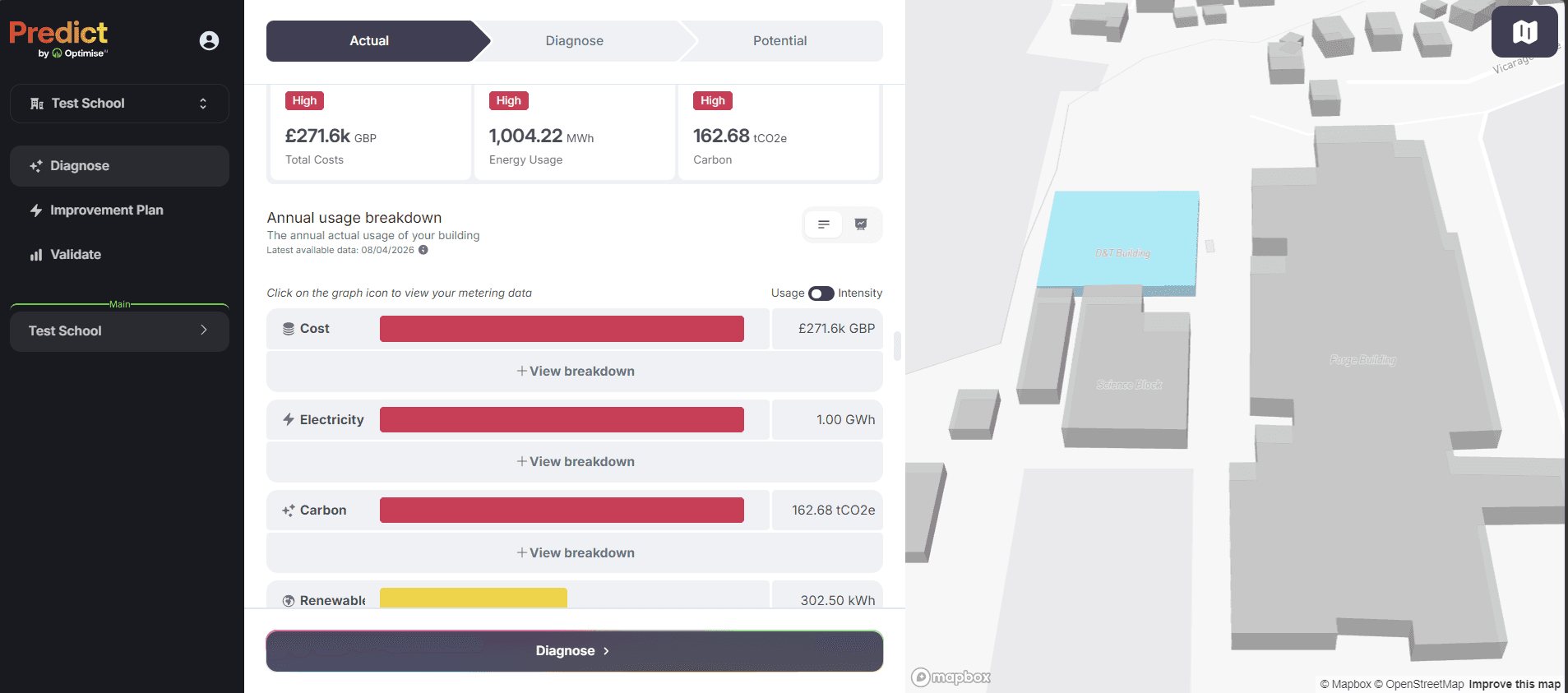
Example of Predict measurement - CF25 school
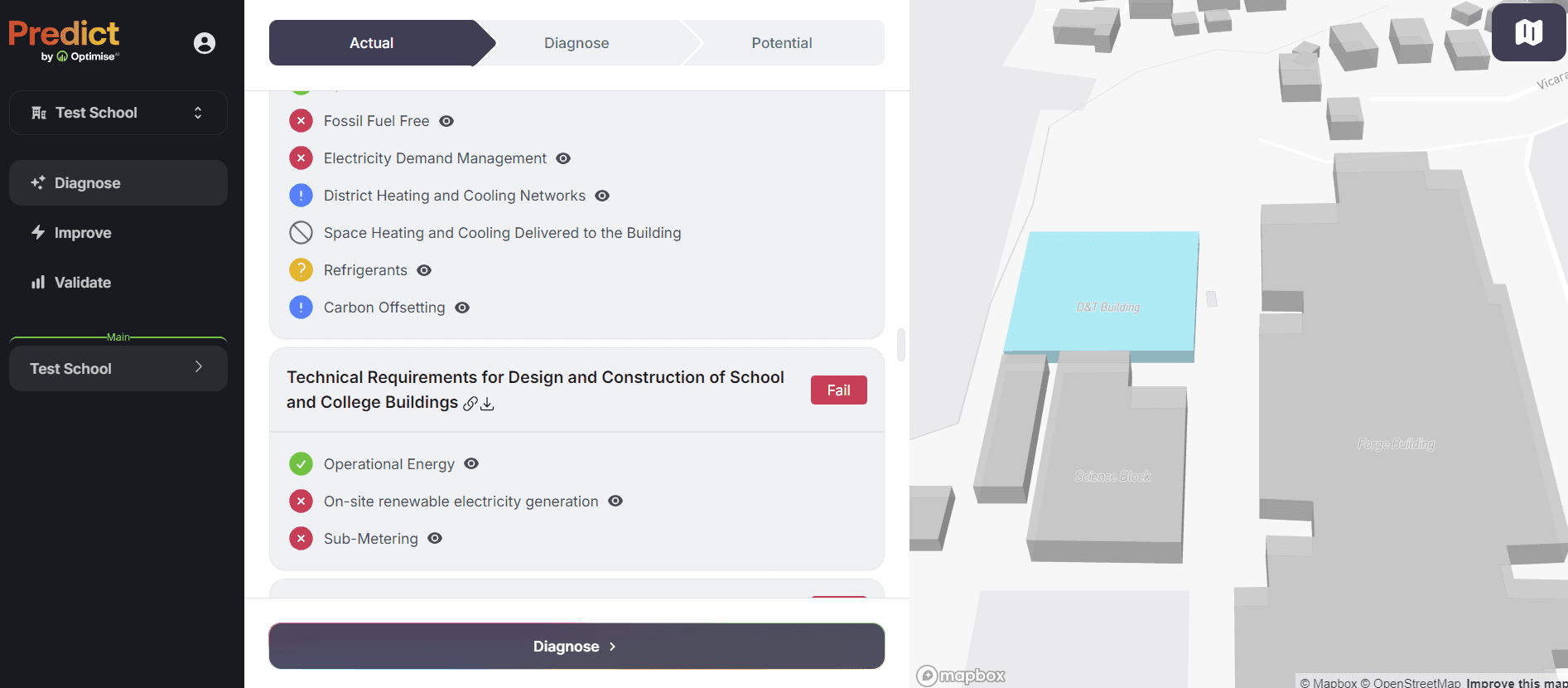
Example of Predict compliance validation - CF25 school
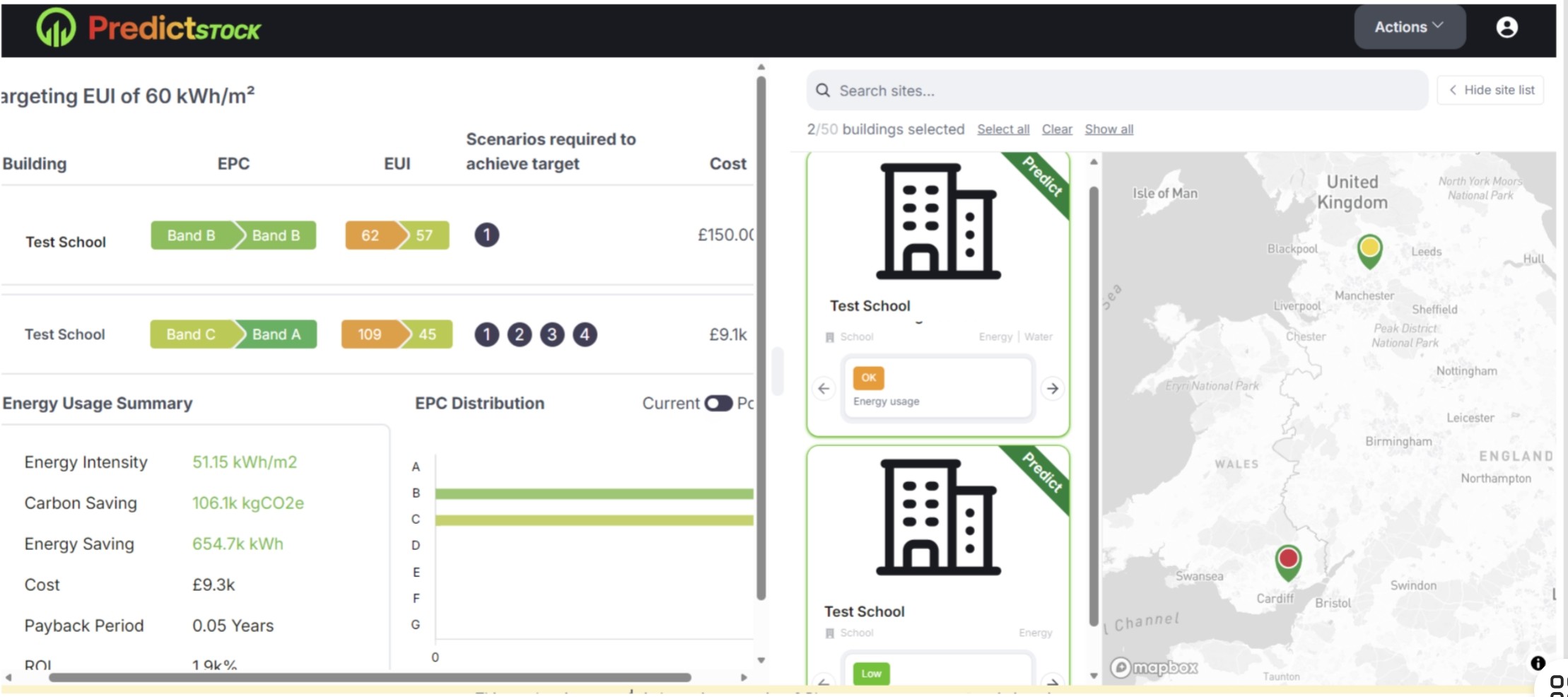
In development - Predict compliance across an estate
Handover is not the finish line. The buildings coming through the CF25 programme and NABERS Design for Performance pathways are some of the best-engineered new stock in the UK. Getting monitoring right from the moment the starting gun fires, genuinely right, aligned to the standard, continuous and scalable, is what determines whether the performance those buildings were designed to deliver is the performance they actually achieve.
If you are working through what this means for your estate or your programme, we are happy to share what we have learned.
Nick Tune
CEO, OptimiseAI
Sources
CCC, Sixth Carbon Budget, Buildings sector summary (Dec 2020): theccc.org.uk/wp-content/uploads/2020/12/Sector-summary-Buildings.pdf. Direct GHG emissions from all buildings were 87 MtCO2e in 2019, equating to 17% of UK total. Homes account for 77% of this; commercial buildings 14%; public buildings 9%. Indirect emissions from electricity use and embodied carbon from construction are not included.
Environmental Audit Committee (May 2022): committees.parliament.uk/committee/62/environmental-audit-committee/news/171103/. The 25% figure encompasses both operational and embodied carbon from the wider built environment.
CCC, 2023 Progress Report to Parliament: theccc.org.uk/publication/2023-progress-report-to-parliament/
AHR Architects, CF25 and Net Zero Carbon (Feb 2026): ahr.co.uk/news/net-zero-and-the-future-learning-estate
DfE's new CF25 framework (Dec 2025)
NABERS: nabers.gov.au/about/nabers-international/nabers-uk. CIBSE Certification: cibsecertification.co.uk/nabers-uk/about-nabers-uk/
CIBSE, NABERS UK recognised by UK Net Zero Carbon Buildings Standard (Mar 2026): cibse.org/policy-advocacy/news/cibse-nabers-uk-energy-for-office-ratings-recognised
POST, Net Zero and the UK's Historic Building Stock (Feb 2025): post.parliament.uk/net-zero-and-the-uk-historic-building-stock/. Parliament, Retrofitting Homes for Net Zero (2024): publications.parliament.uk/pa/cm5901/cmselect/cmesnz/453/report.html
UKGBC, Tackling the Performance Gap, Practical Guide, July 2024: ukgbc.org/wp-content/uploads/2024/07/Takling-the-Performance-Gap.pdf
IES, Meeting EUI Targets in UK DfE Schools (2025): iesve.com/discoveries/view/55548/dfe-school-savings
OptimiseAI internal research, DfE School Output Specification, Technical Annex 2H: Energy (Dec 2023): assets.publishing.service.gov.uk/media/658040c583ba38000de1b741/GDB_Annex_2H-Energy-A-C14.pdf
Chat to us
Copyright ©
2026
optimise-ai.com
Back to Blog
Building Handover Is Not The Finish Line
We're building the best schools, offices and hospitals in a generation. Then leaving their operation to drift. So what does a good post-occupancy operation require?
The UK's legally-binding net zero commitment has seen plenty of progress but now buildings are squarely in the frame.
Direct operational emissions from all buildings, homes, schools, offices and public sector estates, account for approximately 17% of the UK's total greenhouse gas emissions, according to the Climate Change Committee's Sixth Carbon Budget.(1) The CCC's own assessment is unambiguous: progress in decarbonising buildings "has stalled" and remains "broadly insufficient" to meet the 2050 target.(3)
Against that backdrop, a new tier of performance standards has significantly raised expectations for new buildings. BREEAM, Passivhaus, LEED and the WELL Building Standard have long anchored best-practice procurement. Three more recent standards are now reshaping what compliance means for the newest stock:
Standard | Launched | Building category | Core requirements |
UK Net Zero Carbon Buildings Standard | Pilot 2024; full launch 2025 | All building types | Whole-life carbon framework with sector-specific operational EUI targets; requires in-use measured verification, not modelled compliance |
CF25 | January 2026(4) | New schools and colleges, England | Net zero in operation; EUI targets by end-use category assessed via CIBSE TM54; mandatory post-occupancy evaluation (POE) against DfE template; ~£16bn programme(5) |
NABERS UK | November 2020; CIBSE administrator from April 2024(6) | Office buildings | 1–6 star operational rating based on 12 months of actual metered consumption; Base Building, Tenancy and Whole Building ratings; now formally recognised under the UK Net Zero Carbon Buildings Standard(7) |
Sources: AHR Architects (Feb 2026); NABERS / CIBSE Certification; CIBSE (Mar 2026)
The point for anyone managing or developing new buildings: while new stock will remain a small fraction of the UK's total built estate (80% of the buildings occupied in 2050 already exist today(8)), those new buildings, certified to these demanding standards, must carry a disproportionate share of the sector's decarbonisation burden.
Certification at handover and performance in operation are not the same thing
Every building going through CF25 or a NABERS Design for Performance pathway starts with a detailed energy model, typically delivered via IES, Design Builder, PHPP etc, that sets the design-stage EUI target and maps end-use consumption across HVAC, lighting, small power, catering and other regulated and unregulated loads. At handover, compliance is demonstrated against that model. Commissioning is signed off. The standard is met on paper.
And then the starting gun fires. Occupancy changes everything
Post-handover, actual performance diverges from the design model almost immediately. Occupancy patterns differ from modelled assumptions. BMS setpoints are adjusted by facilities teams responding to real comfort complaints rather than design parameters. Scheduling drifts, with plant running longer than programmed, or across unoccupied periods.
"We often find that a building's energy performance in use is different to what we anticipate at the design stage. This discrepancy between design intent and actual energy use is the so-called 'performance gap'... To avoid the performance gap and ensure that our future building stock is energy efficient and operates as intended, it is essential that we begin to design with energy performance in mind, carrying out accurate modelling and ensuring accountability so that the original design principles are preserved through construction stages into operation."
UKGBC, Tackling the Performance Gap, Practical Guide, July 2024(9)
In schools specifically, physical user behaviour introduces gaps that no model anticipates: fire doors propped open during the lunchtime rush to manage pupil flow directly undermine the fabric performance and HVAC efficiency the design relied upon. In offices, trading hours, tenant fit-out changes and cooling system operation all shift from the assumptions underpinning a NABERS target rating.
Each deviation is individually minor. Cumulatively, they can be significant. In conversations with major contractors delivering CF25 schools, a consistent pattern emerges:
one example raised was a school designed to an operational EUI of 45 kWh/m²/yr found to be running at 90, double the design target, for several years before anyone measured it against the standard.
Independent analysis confirms this is not an outlier: operational underperformance is a consistent feature of DfE school stock, and
"the trend of below-target performance within DfE schools looks set to persist"
without deliberate intervention.(10)
The validation process has not kept pace with the standards
CF25 mandates post-occupancy evaluation, but the current approved delivery route has not scaled to meet the ambition of the standard. The DfE's POE template requires metered consumption data across all end-use sub-categories, correlated with environmental monitoring, CO₂, temperature, occupancy, and reported against the design-stage EUI targets via K2N, the DfE-approved reporting tool.
In practice, this process takes two to three weeks of manual effort per building per reporting period and costs in the region of £15,000 to £20,000 per school (just in external consultancy fees)(11) and almost double that in internal costs. For estate portfolios running across multiple tranches of a multi-billion-pound programme, that model does not scale. And because it is structured around annual reporting cycles, performance drift is rarely identified early enough to address before it becomes structural.
For NABERS, the constraint is similar. Maintaining a rating requires a licensed assessor to compile 12 months of metered consumption, apply the normalisation methodology for location, rated hours and occupancy, and submit for annual certification. The rigour is appropriate. But the effort involved means many building owners treat their NABERS rating as a periodic exercise rather than a continuous operational discipline, with the result that a declining performance trajectory often goes undetected until the next assessment cycle forces it into view.
Performance gaps widen in the absence of measurement
The consequence is a sector-wide blind spot. Estate management teams are working from BMS dashboards and utility invoices, useful signals, but not calibrated to the specific normalisation methodology that CF25 or NABERS requires.
Developers who delivered buildings under DfE. NABERS and under Salex grants Design for Performance agreements have limited visibility of whether the operational performance underpinning those commitments is holding. By the time a compliance issue becomes visible, it has typically been accumulating for one to three years, at which point corrective action is more disruptive and more costly.
This matters beyond compliance.
Investor scrutiny of verified building performance is intensifying. Sustainability ratings and certifications are increasingly material to asset valuation, financing terms and occupier decisions. A building that was certified at handover but cannot demonstrate ongoing operational performance is increasingly exposed, not just to regulatory risk, but to commercial risk.
"The performance gap in recent and new buildings is rarely a design failure. It is almost always a lack of effective monitoring strategy. We have ambitious standards and, increasingly, we have the data to inform and implement performance corrective measures. What has been missing is the ability to connect the two, continuously at the required level of granularity, automatically using adapted tools, and at scale."
Professor Yacine Rezgui, Cardiff University
Post-occupancy monitoring is solvable and beneficial
Addressing the performance gap is not primarily a technology question. It is a process and data infrastructure question. Before asking what tools to use, it is worth being clear about what is needed for effective monitoring once the starting gun has fired.
Standard-aligned methodology, not generic energy management
CF25 POE and NABERS UK each have specific normalisation rules, including degree-day adjustment, rated hours, occupancy weighting and end-use category mapping. Generic energy monitoring dashboards do not apply these methodologies. Effective post-occupancy validation needs to be calibrated to the specific standard the building was designed to meet, producing outputs that are directly comparable to the design-stage EUI targets and submittable to the relevant certifying body.Sub-metering granularity across end-use categories
Whole-building consumption data is insufficient for CF25 or NABERS compliance. Both standards require consumption to be broken down by end-use category, covering HVAC, lighting, small power, catering and so on, at the sub-meter level. Monitoring infrastructure that does not capture this granularity cannot identify where within a building the performance gap is occurring, making it impossible to target corrective action effectively.Environmental data integrated alongside energy data
The DfE's CF25 POE template explicitly requires energy consumption to be correlated with indoor environmental conditions, CO₂, temperature and occupancy, to assess the energy cost of maintaining those conditions. Monitoring that captures energy but not environment cannot produce the cross-referenced output the standard requires. Ideally, environmental sensors and energy meters should flow into the same data structure, enabling the two to be analysed together rather than reconciled manually.Continuous, not periodic
Annual reporting cycles catch performance gaps retrospectively. The value of post-occupancy monitoring lies in detecting drift early, ideally within weeks of handover, so that BMS scheduling adjustments, setpoint corrections or occupant behaviour interventions can be made before a minor deviation compounds into a structural underperformance. Monitoring at 30-minute resolution, mapped to the design energy model, gives estate managers and facilities teams the lead time to act.Scalable across a portfolio, not just a single building
For estate managers and developers managing multiple CF25 schools or a portfolio of NABERS-rated offices, per-building manual effort is not viable at scale. Effective monitoring infrastructure needs to be deployable in a repeatable, low-friction way, with standardised naming conventions, consistent meter mapping and a data model that accommodates the pattern-book nature of programmes like CF25, where the same core building types repeat across multiple sites. The first deployment should be the hardest; subsequent ones should be materially faster.Outputs that connect to the standard, not just to the dashboard
The end goal is not a performance dashboard. It is a validated compliance position against a defined standard. Monitoring outputs need to map directly to the reporting format required by CF25 POE or NABERS certification, so that the compliance case is continuously maintained rather than reconstructed manually at each reporting cycle.
The practical test: could you submit this data to the DfE or to your NABERS assessor without a three-week reconciliation exercise?
Verified performance in operation is the direction of travel
The shift from modelled compliance to measured in-use verification is already embedded in the standards that matter most. The UK Net Zero Carbon Buildings Standard requires it. NABERS UK is built on it. CF25 mandates it via POE and grant programmes such as Salix require measurement and validation.
What the sector has lacked, until recently, is a practical infrastructure for delivering it continuously, at the sub-building level, in a form that connects directly to the relevant standard's methodology, without requiring weeks of manual effort per building per year.
At OptimiseAI, our work on the CF25 programme has given us a detailed view of what this infrastructure needs to look like in practice. The requirements above are drawn directly from that experience. We have been building Predict to meet them for CF25, and we are extending the same approach to NABERS UK. We are sharing this framework because we think the sector needs it, regardless of what technology is used to implement it.
Example of Predict measurement - CF25 school
Example of Predict compliance validation - CF25 school
In development - Predict compliance across an estate
Handover is not the finish line. The buildings coming through the CF25 programme and NABERS Design for Performance pathways are some of the best-engineered new stock in the UK. Getting monitoring right from the moment the starting gun fires, genuinely right, aligned to the standard, continuous and scalable, is what determines whether the performance those buildings were designed to deliver is the performance they actually achieve.
If you are working through what this means for your estate or your programme, we are happy to share what we have learned.
Nick Tune
CEO, OptimiseAI
Sources
CCC, Sixth Carbon Budget, Buildings sector summary (Dec 2020): theccc.org.uk/wp-content/uploads/2020/12/Sector-summary-Buildings.pdf. Direct GHG emissions from all buildings were 87 MtCO2e in 2019, equating to 17% of UK total. Homes account for 77% of this; commercial buildings 14%; public buildings 9%. Indirect emissions from electricity use and embodied carbon from construction are not included.
Environmental Audit Committee (May 2022): committees.parliament.uk/committee/62/environmental-audit-committee/news/171103/. The 25% figure encompasses both operational and embodied carbon from the wider built environment.
CCC, 2023 Progress Report to Parliament: theccc.org.uk/publication/2023-progress-report-to-parliament/
AHR Architects, CF25 and Net Zero Carbon (Feb 2026): ahr.co.uk/news/net-zero-and-the-future-learning-estate
DfE's new CF25 framework (Dec 2025)
NABERS: nabers.gov.au/about/nabers-international/nabers-uk. CIBSE Certification: cibsecertification.co.uk/nabers-uk/about-nabers-uk/
CIBSE, NABERS UK recognised by UK Net Zero Carbon Buildings Standard (Mar 2026): cibse.org/policy-advocacy/news/cibse-nabers-uk-energy-for-office-ratings-recognised
POST, Net Zero and the UK's Historic Building Stock (Feb 2025): post.parliament.uk/net-zero-and-the-uk-historic-building-stock/. Parliament, Retrofitting Homes for Net Zero (2024): publications.parliament.uk/pa/cm5901/cmselect/cmesnz/453/report.html
UKGBC, Tackling the Performance Gap, Practical Guide, July 2024: ukgbc.org/wp-content/uploads/2024/07/Takling-the-Performance-Gap.pdf
IES, Meeting EUI Targets in UK DfE Schools (2025): iesve.com/discoveries/view/55548/dfe-school-savings
OptimiseAI internal research, DfE School Output Specification, Technical Annex 2H: Energy (Dec 2023): assets.publishing.service.gov.uk/media/658040c583ba38000de1b741/GDB_Annex_2H-Energy-A-C14.pdf
Back to Blog
CF25
Explore automated measurement for CF25
Copyright ©
2026
optimise-ai.com
Back to Blog
Building Handover Is Not The Finish Line
We're building the best schools, offices and hospitals in a generation. Then leaving their operation to drift. So what does a good post-occupancy operation require?
The UK's legally-binding net zero commitment has seen plenty of progress but now buildings are squarely in the frame.
Direct operational emissions from all buildings, homes, schools, offices and public sector estates, account for approximately 17% of the UK's total greenhouse gas emissions, according to the Climate Change Committee's Sixth Carbon Budget.(1) The CCC's own assessment is unambiguous: progress in decarbonising buildings "has stalled" and remains "broadly insufficient" to meet the 2050 target.(3)
Against that backdrop, a new tier of performance standards has significantly raised expectations for new buildings. BREEAM, Passivhaus, LEED and the WELL Building Standard have long anchored best-practice procurement. Three more recent standards are now reshaping what compliance means for the newest stock:
Standard | Launched | Building category | Core requirements |
UK Net Zero Carbon Buildings Standard | Pilot 2024; full launch 2025 | All building types | Whole-life carbon framework with sector-specific operational EUI targets; requires in-use measured verification, not modelled compliance |
CF25 | January 2026(4) | New schools and colleges, England | Net zero in operation; EUI targets by end-use category assessed via CIBSE TM54; mandatory post-occupancy evaluation (POE) against DfE template; ~£16bn programme(5) |
NABERS UK | November 2020; CIBSE administrator from April 2024(6) | Office buildings | 1–6 star operational rating based on 12 months of actual metered consumption; Base Building, Tenancy and Whole Building ratings; now formally recognised under the UK Net Zero Carbon Buildings Standard(7) |
Sources: AHR Architects (Feb 2026); NABERS / CIBSE Certification; CIBSE (Mar 2026)
The point for anyone managing or developing new buildings: while new stock will remain a small fraction of the UK's total built estate (80% of the buildings occupied in 2050 already exist today(8)), those new buildings, certified to these demanding standards, must carry a disproportionate share of the sector's decarbonisation burden.
Certification at handover and performance in operation are not the same thing
Every building going through CF25 or a NABERS Design for Performance pathway starts with a detailed energy model, typically delivered via IES, Design Builder, PHPP etc, that sets the design-stage EUI target and maps end-use consumption across HVAC, lighting, small power, catering and other regulated and unregulated loads. At handover, compliance is demonstrated against that model. Commissioning is signed off. The standard is met on paper.
And then the starting gun fires. Occupancy changes everything
Post-handover, actual performance diverges from the design model almost immediately. Occupancy patterns differ from modelled assumptions. BMS setpoints are adjusted by facilities teams responding to real comfort complaints rather than design parameters. Scheduling drifts, with plant running longer than programmed, or across unoccupied periods.
"We often find that a building's energy performance in use is different to what we anticipate at the design stage. This discrepancy between design intent and actual energy use is the so-called 'performance gap'... To avoid the performance gap and ensure that our future building stock is energy efficient and operates as intended, it is essential that we begin to design with energy performance in mind, carrying out accurate modelling and ensuring accountability so that the original design principles are preserved through construction stages into operation."
UKGBC, Tackling the Performance Gap, Practical Guide, July 2024(9)
In schools specifically, physical user behaviour introduces gaps that no model anticipates: fire doors propped open during the lunchtime rush to manage pupil flow directly undermine the fabric performance and HVAC efficiency the design relied upon. In offices, trading hours, tenant fit-out changes and cooling system operation all shift from the assumptions underpinning a NABERS target rating.
Each deviation is individually minor. Cumulatively, they can be significant. In conversations with major contractors delivering CF25 schools, a consistent pattern emerges:
one example raised was a school designed to an operational EUI of 45 kWh/m²/yr found to be running at 90, double the design target, for several years before anyone measured it against the standard.
Independent analysis confirms this is not an outlier: operational underperformance is a consistent feature of DfE school stock, and
"the trend of below-target performance within DfE schools looks set to persist"
without deliberate intervention.(10)
The validation process has not kept pace with the standards
CF25 mandates post-occupancy evaluation, but the current approved delivery route has not scaled to meet the ambition of the standard. The DfE's POE template requires metered consumption data across all end-use sub-categories, correlated with environmental monitoring, CO₂, temperature, occupancy, and reported against the design-stage EUI targets via K2N, the DfE-approved reporting tool.
In practice, this process takes two to three weeks of manual effort per building per reporting period and costs in the region of £15,000 to £20,000 per school (just in external consultancy fees)(11) and almost double that in internal costs. For estate portfolios running across multiple tranches of a multi-billion-pound programme, that model does not scale. And because it is structured around annual reporting cycles, performance drift is rarely identified early enough to address before it becomes structural.
For NABERS, the constraint is similar. Maintaining a rating requires a licensed assessor to compile 12 months of metered consumption, apply the normalisation methodology for location, rated hours and occupancy, and submit for annual certification. The rigour is appropriate. But the effort involved means many building owners treat their NABERS rating as a periodic exercise rather than a continuous operational discipline, with the result that a declining performance trajectory often goes undetected until the next assessment cycle forces it into view.
Performance gaps widen in the absence of measurement
The consequence is a sector-wide blind spot. Estate management teams are working from BMS dashboards and utility invoices, useful signals, but not calibrated to the specific normalisation methodology that CF25 or NABERS requires.
Developers who delivered buildings under DfE. NABERS and under Salex grants Design for Performance agreements have limited visibility of whether the operational performance underpinning those commitments is holding. By the time a compliance issue becomes visible, it has typically been accumulating for one to three years, at which point corrective action is more disruptive and more costly.
This matters beyond compliance.
Investor scrutiny of verified building performance is intensifying. Sustainability ratings and certifications are increasingly material to asset valuation, financing terms and occupier decisions. A building that was certified at handover but cannot demonstrate ongoing operational performance is increasingly exposed, not just to regulatory risk, but to commercial risk.
"The performance gap in recent and new buildings is rarely a design failure. It is almost always a lack of effective monitoring strategy. We have ambitious standards and, increasingly, we have the data to inform and implement performance corrective measures. What has been missing is the ability to connect the two, continuously at the required level of granularity, automatically using adapted tools, and at scale."
Professor Yacine Rezgui, Cardiff University
Post-occupancy monitoring is solvable and beneficial
Addressing the performance gap is not primarily a technology question. It is a process and data infrastructure question. Before asking what tools to use, it is worth being clear about what is needed for effective monitoring once the starting gun has fired.
Standard-aligned methodology, not generic energy management
CF25 POE and NABERS UK each have specific normalisation rules, including degree-day adjustment, rated hours, occupancy weighting and end-use category mapping. Generic energy monitoring dashboards do not apply these methodologies. Effective post-occupancy validation needs to be calibrated to the specific standard the building was designed to meet, producing outputs that are directly comparable to the design-stage EUI targets and submittable to the relevant certifying body.Sub-metering granularity across end-use categories
Whole-building consumption data is insufficient for CF25 or NABERS compliance. Both standards require consumption to be broken down by end-use category, covering HVAC, lighting, small power, catering and so on, at the sub-meter level. Monitoring infrastructure that does not capture this granularity cannot identify where within a building the performance gap is occurring, making it impossible to target corrective action effectively.Environmental data integrated alongside energy data
The DfE's CF25 POE template explicitly requires energy consumption to be correlated with indoor environmental conditions, CO₂, temperature and occupancy, to assess the energy cost of maintaining those conditions. Monitoring that captures energy but not environment cannot produce the cross-referenced output the standard requires. Ideally, environmental sensors and energy meters should flow into the same data structure, enabling the two to be analysed together rather than reconciled manually.Continuous, not periodic
Annual reporting cycles catch performance gaps retrospectively. The value of post-occupancy monitoring lies in detecting drift early, ideally within weeks of handover, so that BMS scheduling adjustments, setpoint corrections or occupant behaviour interventions can be made before a minor deviation compounds into a structural underperformance. Monitoring at 30-minute resolution, mapped to the design energy model, gives estate managers and facilities teams the lead time to act.Scalable across a portfolio, not just a single building
For estate managers and developers managing multiple CF25 schools or a portfolio of NABERS-rated offices, per-building manual effort is not viable at scale. Effective monitoring infrastructure needs to be deployable in a repeatable, low-friction way, with standardised naming conventions, consistent meter mapping and a data model that accommodates the pattern-book nature of programmes like CF25, where the same core building types repeat across multiple sites. The first deployment should be the hardest; subsequent ones should be materially faster.Outputs that connect to the standard, not just to the dashboard
The end goal is not a performance dashboard. It is a validated compliance position against a defined standard. Monitoring outputs need to map directly to the reporting format required by CF25 POE or NABERS certification, so that the compliance case is continuously maintained rather than reconstructed manually at each reporting cycle.
The practical test: could you submit this data to the DfE or to your NABERS assessor without a three-week reconciliation exercise?
Verified performance in operation is the direction of travel
The shift from modelled compliance to measured in-use verification is already embedded in the standards that matter most. The UK Net Zero Carbon Buildings Standard requires it. NABERS UK is built on it. CF25 mandates it via POE and grant programmes such as Salix require measurement and validation.
What the sector has lacked, until recently, is a practical infrastructure for delivering it continuously, at the sub-building level, in a form that connects directly to the relevant standard's methodology, without requiring weeks of manual effort per building per year.
At OptimiseAI, our work on the CF25 programme has given us a detailed view of what this infrastructure needs to look like in practice. The requirements above are drawn directly from that experience. We have been building Predict to meet them for CF25, and we are extending the same approach to NABERS UK. We are sharing this framework because we think the sector needs it, regardless of what technology is used to implement it.
Example of Predict measurement - CF25 school
Example of Predict compliance validation - CF25 school
In development - Predict compliance across an estate
Handover is not the finish line. The buildings coming through the CF25 programme and NABERS Design for Performance pathways are some of the best-engineered new stock in the UK. Getting monitoring right from the moment the starting gun fires, genuinely right, aligned to the standard, continuous and scalable, is what determines whether the performance those buildings were designed to deliver is the performance they actually achieve.
If you are working through what this means for your estate or your programme, we are happy to share what we have learned.
Nick Tune
CEO, OptimiseAI
Sources
CCC, Sixth Carbon Budget, Buildings sector summary (Dec 2020): theccc.org.uk/wp-content/uploads/2020/12/Sector-summary-Buildings.pdf. Direct GHG emissions from all buildings were 87 MtCO2e in 2019, equating to 17% of UK total. Homes account for 77% of this; commercial buildings 14%; public buildings 9%. Indirect emissions from electricity use and embodied carbon from construction are not included.
Environmental Audit Committee (May 2022): committees.parliament.uk/committee/62/environmental-audit-committee/news/171103/. The 25% figure encompasses both operational and embodied carbon from the wider built environment.
CCC, 2023 Progress Report to Parliament: theccc.org.uk/publication/2023-progress-report-to-parliament/
AHR Architects, CF25 and Net Zero Carbon (Feb 2026): ahr.co.uk/news/net-zero-and-the-future-learning-estate
DfE's new CF25 framework (Dec 2025)
NABERS: nabers.gov.au/about/nabers-international/nabers-uk. CIBSE Certification: cibsecertification.co.uk/nabers-uk/about-nabers-uk/
CIBSE, NABERS UK recognised by UK Net Zero Carbon Buildings Standard (Mar 2026): cibse.org/policy-advocacy/news/cibse-nabers-uk-energy-for-office-ratings-recognised
POST, Net Zero and the UK's Historic Building Stock (Feb 2025): post.parliament.uk/net-zero-and-the-uk-historic-building-stock/. Parliament, Retrofitting Homes for Net Zero (2024): publications.parliament.uk/pa/cm5901/cmselect/cmesnz/453/report.html
UKGBC, Tackling the Performance Gap, Practical Guide, July 2024: ukgbc.org/wp-content/uploads/2024/07/Takling-the-Performance-Gap.pdf
IES, Meeting EUI Targets in UK DfE Schools (2025): iesve.com/discoveries/view/55548/dfe-school-savings
OptimiseAI internal research, DfE School Output Specification, Technical Annex 2H: Energy (Dec 2023): assets.publishing.service.gov.uk/media/658040c583ba38000de1b741/GDB_Annex_2H-Energy-A-C14.pdf
Back to Blog
CF25
Explore automated measurement for CF25
Copyright ©
2026
optimise-ai.com