

Back to Blog
Want to be the first to test Estate View?
We are looking for early stage partners who are willing to test across their estates.
Book a time to discuss

Why we need EPC + live data
EPCs matter, and they’re about to matter more. But two decades of research say a certificate built on a theoretical model can only ever tell part of the story.
Here’s our reasoned evidence and answer to it, we call it 'EPC + live data', and how measuring what your buildings actually do leads to better EPC outcomes.
The certificate everyone has
If you own or occupy a non-domestic building in the UK, you almost certainly have an Energy Performance Certificate. The government requires one whenever a building is constructed, sold or let, and the direction of travel is clear: the proposed trajectory for commercial property points to EPC B by 2030, and the market is already pricing it in.
So the EPC is worth taking seriously. It gives every building a common yardstick, and it has done real work in pushing energy performance up the agenda. But it’s important to understand what it is and what it isn’t.
What an EPC actually measures
An EPC is produced from a set survey. An accredited assessor records the building’s fabric, glazing, heating, lighting and ventilation, and feeds them into a standardised simulation with standard assumptions: standard occupancy hours, standard weather, standard patterns of use. The output is an asset rating, a theoretical statement of what the building should deliver if it were used the standard way. No meter reading goes into it.
That makes it useful for comparing similar buildings at the point of sale or lease. It also means an EPC says remarkably little about how your building is performing right now. Our co-founder Nick Tune puts it like this:
“EPC is just a theoretical model. By itself not that helpful. However when accompanied by live data, machine learning, and a building physics model it provides deeper insights. EPCs are just purely one leg of a chair.”
Nick Tune, co-founder, Optimise AI
And when we put that view to a practising energy assessor, someone who produces EPCs for a living, her response was disarmingly direct in clarifying the limited accuracy.
What the published research says
This isn’t just our view, or hers. The gap between modelled and measured energy performance is one of the best-documented findings in building science, researchers call it the “energy performance gap”, and Pieter de Wilde’s much-cited 2014 paper gave the field its framework for investigating it.
The numbers are striking. A systematic review of the evidence in non-domestic buildings, published in Frontiers in Mechanical Engineering, found that across 62 case-study buildings:
“The average discrepancy between predicted and measured energy use is +34%, with a [standard deviation] of 55%.”
Van Dronkelaar et al. (2016), “A Review of the Energy Performance Gap and Its Underlying Causes in Non-Domestic Buildings”
Innovate UK’s four-year Building Performance Evaluation programme, which measured real buildings after handover, found the gap wider still: non-domestic buildings used on average around 3.6 times more energy than their design predictions, with carbon emissions in some cases reaching ten times the rate calculated for Building Regulations compliance.
Most telling of all is what the UK’s own commercial property industry found when it looked at its portfolios. The Better Buildings Partnership, whose members own and manage over £200bn of UK real estate, compared the EPC ratings of its members’ buildings with their measured energy intensity, and told the government in its formal evidence:
“It should be noted that EPCs are not an indicator of operational energy use… When looking at the relationship between EPC ratings and operational energy intensity, the data shows no correlation between how efficiently a building uses energy and its EPC rating.”
Better Buildings Partnership, response to the Government’s EPC Call for Evidence (2018), based on Real Estate Environmental Benchmark data
No correlation
A building with a good certificate can be a heavy consumer; a building with a modest certificate can be running beautifully. The same pattern shows up in homes: a study of nearly 10,000 Irish dwellings found actual energy use was essentially “unresponsive to the EPC”, with households across the rating bands using almost identical amounts of energy. The BBP’s conclusion to government was equally clear, it “strongly recommends the introduction of operational ratings for commercial properties as the most appropriate tool to drive energy performance improvements.”
Why the gap exists: buildings are run by people
The research is just as clear on why. The Frontiers review identified occupant behaviour as one of the dominant causes of the gap, with an estimated effect of anywhere between 10% and 80% on a building’s energy use, alongside modelling assumptions and day-to-day operational practice.
Take a school. A certificate assumes the doors are kept closed and the heating runs to a sensible schedule. Then a real lunchtime arrives, the hall needs to turn around six hundred children in forty minutes, and someone props the door open so the queue moves more quickly. A perfectly rational decision, and for the rest of the winter the school energy management software is quietly working against an open door. Nothing about the EPC changes. The energy bill does.
Multiply that by every operational decision in a working building: occupancy hours that stretch, equipment that gets added, set-points that creep, controls that nobody quite owns. Even well-designed buildings drift once the people change, a sustainability lead at a property management firm described exactly this pattern with building management systems:
“As soon as you get a building manager in there that doesn’t know how to use it, then it just kind of sits there.”
Sustainability Lead, property management firm
And buildings change faster than their certificates
The second cause is time. An EPC is valid for ten years, and buildings don’t stand still for ten years. Floors get reconfigured, partitions go up, tenants change, a storage room becomes a server room, opening hours extend. The certificate on the wall may describe a building that, in operational terms, no longer exists, as the BBP noted in the same evidence, operational data needs monitoring at least annually, while an EPC can sit untouched for a decade.
The gap runs both ways, and that’s the interesting part. When we reviewed one branch for a client, the certificate and the meter told two different stories:
“It’s saying that it’s EPC E rated, but it’s performing better, it’s performing more like a C.”
Nick Tune, reviewing a branch building on a live demo
A building can outperform a modest certificate because it’s well run, or quietly underperform a good one because of how it’s used. If you’re deciding where to spend your next pound of capital, that’s precisely the thing you need to know.
The industry is already moving to measured performance
The response across the sector points the same way:
Display Energy Certificates have rated public buildings on actual annual consumption since 2008.
Australia’s NABERS scheme, which rates offices on measured performance and now covers most of that market, has driven a roughly 36% improvement in the energy intensity of rated landlord services, and was brought to Britain as NABERS UK in 2020 through the Better Buildings Partnership’s Design for Performance initiative.
The frameworks now defining net zero for UK buildings, UKGBC, LETI, the RIBA 2030 Climate Challenge and the UK Net Zero Carbon Buildings Standard, all set their targets in measured energy use intensity (EUI, in kWh/m² per year), not in EPC bands.
Scotland’s public-sector net zero route maps are framed the same way.
Our answer: EPC + live data
Here’s the thing, though: the EPC isn’t going anywhere, and it shouldn’t. It’s the legal requirement, the common language of sale and lease, and the benchmark your board, your lenders and your regulators will ask about. The practical question is how to keep the certificate and add the measurement. That’s what our EPC + live data approach does.
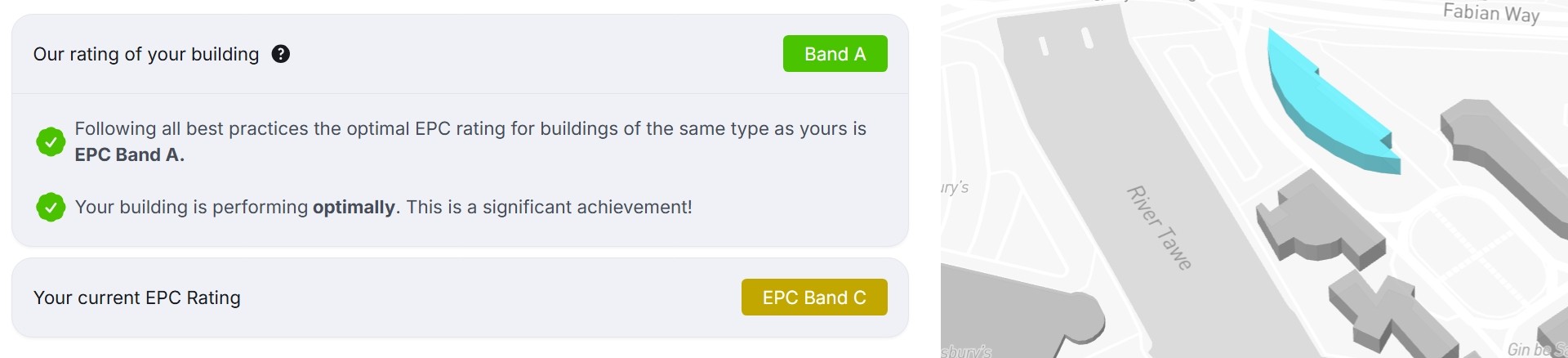
When we review a non-domestic building, we start by identifying its EPC. Then we add what the certificate can’t see: a rating built from your actual metered consumption, closer in spirit to a Display Energy Certificate, that establishes whether the building is behaving efficiently for a building of its type with that EPC.
Where it’s already outperforming, we can show it, with the data to prove it. Where it isn’t, the same data pinpoints the opportunities, and we model the improvement measures available, fabric, plant, controls, renewables, with costs, savings, carbon impact and payback for each.
Because the baseline is measured rather than assumed, every recommendation is trackable: you can watch the meter confirm the saving after the work is done. It’s the reason the Head of Sustainability at ScotRail chose to build business cases on our platform:
“The reason why I like that is that it’s based on our actual direct feeds of our utility consumption… so whatever business case we spit out, we can say, well, that’s based on our actual live data, so we can track that.”
Head of Sustainability, large transport provider
One measured scale for your whole estate
EPC + live data also solves a problem the certificate was never designed for: comparing your own buildings with each other. Because every building in your portfolio is rated on the same measured basis, you can rank your estate on how it actually performs, spot the quiet over-achievers worth learning from, and the buildings where the next pound of capital will work hardest. And because the comparison can be made against your own portfolio’s peers, buildings with similar use, hours and equipment, it’s more actionable than a generic industry benchmark.
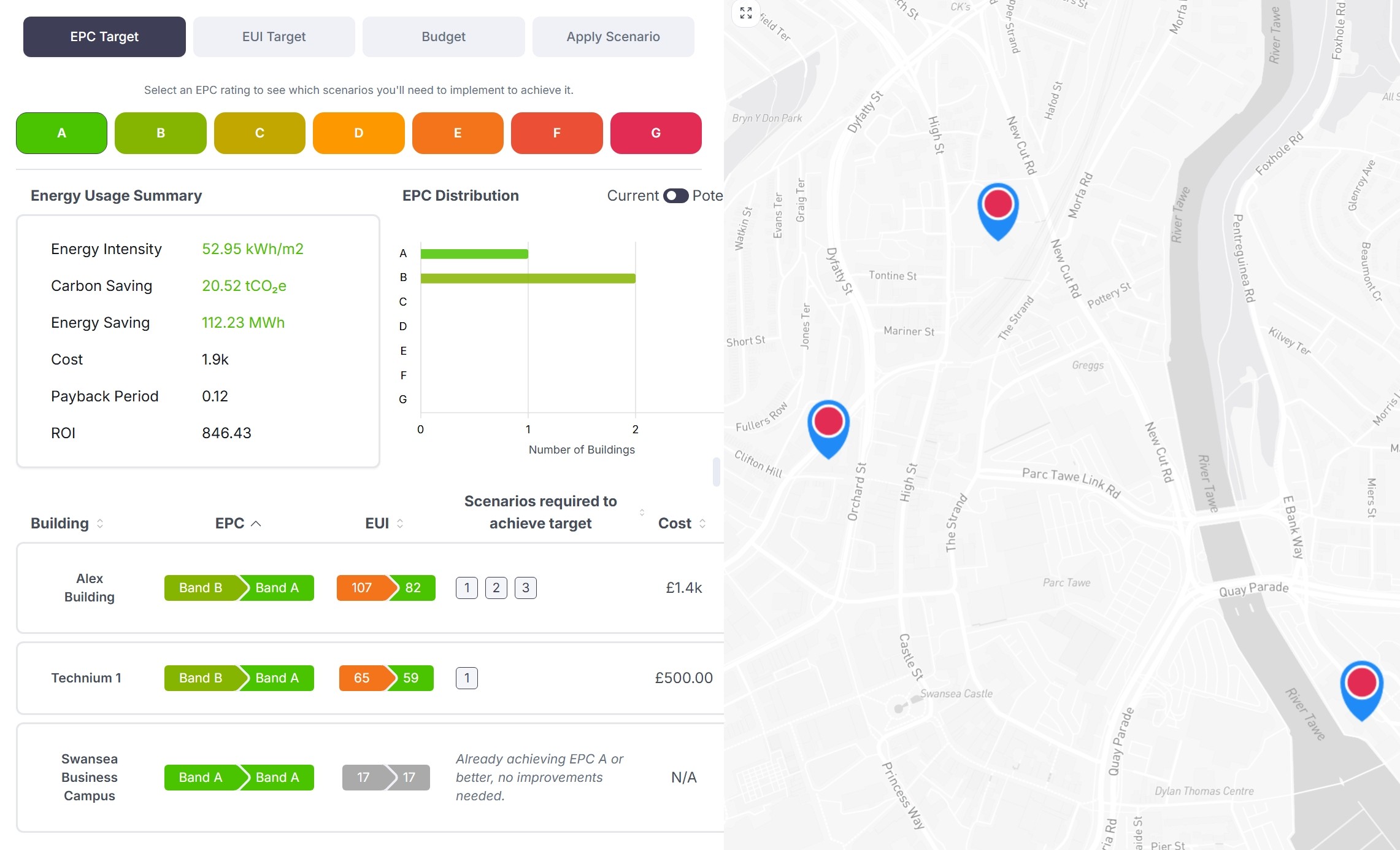
Alongside the rating itself, we report the measures the net zero frameworks are built on, for every building and for the estate as a whole: energy use intensity (kWh/m² per year, directly comparable with LETI, UKGBC and Scottish public-sector targets), carbon intensity (kgCO₂e/m²) and cost intensity (£/m²). So whether your reporting conversation is framed in EPC bands, EUI targets or carbon budgets, the same live data answers it.
Better performance, and a better certificate too
None of this is an argument against the EPC. It’s an argument for putting it in its proper place: a standardised benchmark, not a performance measurement, and the research above shows what happens when the two are confused. The good news is that they pull in the same direction. The measures we recommend are very likely to improve your EPC, because most things that reduce real consumption, better fabric, better plant, better controls, also improve the modelled rating. But they will certainly improve your actual energy use, your costs and your carbon emissions. You get the certificate the regulation asks for, and the performance the certificate was always meant to stand for.
With 2030 approaching, the estates that move first will be the ones that know exactly which buildings to improve and in what order, as one FM energy manager put it on a recent call:
“You’ve got to start looking long term now. It’s coming up to 2030, you’re getting closer and you need to start doing a lot more stuff to make them more energy efficient.”
Energy manager, consultancy
That’s what EPC + live data is for: instant clarity on how your buildings are really performing, measured the way the net zero frameworks measure it, and a costed journey map to make them better. The certificate will follow.
References
Better Buildings Partnership (2018), Energy Performance Certificates for Buildings — Call for Evidence response (Real Estate Environmental Benchmark data; see also BBP & JLL, A Tale of Two Buildings).

Frontiers in Mechanical Engineering. Van Dronkelaar, C., Dowson, M., Burman, E., Spataru, C. & Mumovic, D. (2016), A Review of the Energy Performance Gap and Its Underlying Causes in Non-Domestic Buildings,

https://www.frontiersin.org/journals/mechanical-engineering/articles/10.3389/fmech.2015.00017/full
Innovate UK (2016), Building Performance Evaluation Programme: Findings from non-domestic projects.

de Wilde, P. (2014), The gap between predicted and measured energy performance of buildings: A framework for investigation, Automation in Construction 41, 40–49.
https://www.sciencedirect.com/science/article/abs/pii/S092658051400034X
Coyne, B. & Denny, E. (2021), Mind the Energy Performance Gap: testing the accuracy of building Energy Performance Certificates in Ireland, Energy Efficiency.
https://pmc.ncbi.nlm.nih.gov/articles/PMC8550629/
Better Buildings Partnership, Design for Performance / NABERS UK. https://www.betterbuildingspartnership.co.uk/our-priorities/design-performance
UKGBC (2020), Energy performance targets for net zero carbon offices (EUI-based targets).
Chat to us
Copyright ©
2026
optimise-ai.com
Back to Blog
Why we need EPC + live data
EPCs matter, and they’re about to matter more. But two decades of research say a certificate built on a theoretical model can only ever tell part of the story.
Here’s our reasoned evidence and answer to it, we call it 'EPC + live data', and how measuring what your buildings actually do leads to better EPC outcomes.
The certificate everyone has
If you own or occupy a non-domestic building in the UK, you almost certainly have an Energy Performance Certificate. The government requires one whenever a building is constructed, sold or let, and the direction of travel is clear: the proposed trajectory for commercial property points to EPC B by 2030, and the market is already pricing it in.
So the EPC is worth taking seriously. It gives every building a common yardstick, and it has done real work in pushing energy performance up the agenda. But it’s important to understand what it is and what it isn’t.
What an EPC actually measures
An EPC is produced from a set survey. An accredited assessor records the building’s fabric, glazing, heating, lighting and ventilation, and feeds them into a standardised simulation with standard assumptions: standard occupancy hours, standard weather, standard patterns of use. The output is an asset rating, a theoretical statement of what the building should deliver if it were used the standard way. No meter reading goes into it.
That makes it useful for comparing similar buildings at the point of sale or lease. It also means an EPC says remarkably little about how your building is performing right now. Our co-founder Nick Tune puts it like this:
“EPC is just a theoretical model. By itself not that helpful. However when accompanied by live data, machine learning, and a building physics model it provides deeper insights. EPCs are just purely one leg of a chair.”
Nick Tune, co-founder, Optimise AI
And when we put that view to a practising energy assessor, someone who produces EPCs for a living, her response was disarmingly direct in clarifying the limited accuracy.
What the published research says
This isn’t just our view, or hers. The gap between modelled and measured energy performance is one of the best-documented findings in building science, researchers call it the “energy performance gap”, and Pieter de Wilde’s much-cited 2014 paper gave the field its framework for investigating it.
The numbers are striking. A systematic review of the evidence in non-domestic buildings, published in Frontiers in Mechanical Engineering, found that across 62 case-study buildings:
“The average discrepancy between predicted and measured energy use is +34%, with a [standard deviation] of 55%.”
Van Dronkelaar et al. (2016), “A Review of the Energy Performance Gap and Its Underlying Causes in Non-Domestic Buildings”
Innovate UK’s four-year Building Performance Evaluation programme, which measured real buildings after handover, found the gap wider still: non-domestic buildings used on average around 3.6 times more energy than their design predictions, with carbon emissions in some cases reaching ten times the rate calculated for Building Regulations compliance.
Most telling of all is what the UK’s own commercial property industry found when it looked at its portfolios. The Better Buildings Partnership, whose members own and manage over £200bn of UK real estate, compared the EPC ratings of its members’ buildings with their measured energy intensity, and told the government in its formal evidence:
“It should be noted that EPCs are not an indicator of operational energy use… When looking at the relationship between EPC ratings and operational energy intensity, the data shows no correlation between how efficiently a building uses energy and its EPC rating.”
Better Buildings Partnership, response to the Government’s EPC Call for Evidence (2018), based on Real Estate Environmental Benchmark data
No correlation
A building with a good certificate can be a heavy consumer; a building with a modest certificate can be running beautifully. The same pattern shows up in homes: a study of nearly 10,000 Irish dwellings found actual energy use was essentially “unresponsive to the EPC”, with households across the rating bands using almost identical amounts of energy. The BBP’s conclusion to government was equally clear, it “strongly recommends the introduction of operational ratings for commercial properties as the most appropriate tool to drive energy performance improvements.”
Why the gap exists: buildings are run by people
The research is just as clear on why. The Frontiers review identified occupant behaviour as one of the dominant causes of the gap, with an estimated effect of anywhere between 10% and 80% on a building’s energy use, alongside modelling assumptions and day-to-day operational practice.
Take a school. A certificate assumes the doors are kept closed and the heating runs to a sensible schedule. Then a real lunchtime arrives, the hall needs to turn around six hundred children in forty minutes, and someone props the door open so the queue moves more quickly. A perfectly rational decision, and for the rest of the winter the school energy management software is quietly working against an open door. Nothing about the EPC changes. The energy bill does.
Multiply that by every operational decision in a working building: occupancy hours that stretch, equipment that gets added, set-points that creep, controls that nobody quite owns. Even well-designed buildings drift once the people change, a sustainability lead at a property management firm described exactly this pattern with building management systems:
“As soon as you get a building manager in there that doesn’t know how to use it, then it just kind of sits there.”
Sustainability Lead, property management firm
And buildings change faster than their certificates
The second cause is time. An EPC is valid for ten years, and buildings don’t stand still for ten years. Floors get reconfigured, partitions go up, tenants change, a storage room becomes a server room, opening hours extend. The certificate on the wall may describe a building that, in operational terms, no longer exists, as the BBP noted in the same evidence, operational data needs monitoring at least annually, while an EPC can sit untouched for a decade.
The gap runs both ways, and that’s the interesting part. When we reviewed one branch for a client, the certificate and the meter told two different stories:
“It’s saying that it’s EPC E rated, but it’s performing better, it’s performing more like a C.”
Nick Tune, reviewing a branch building on a live demo
A building can outperform a modest certificate because it’s well run, or quietly underperform a good one because of how it’s used. If you’re deciding where to spend your next pound of capital, that’s precisely the thing you need to know.
The industry is already moving to measured performance
The response across the sector points the same way:
Display Energy Certificates have rated public buildings on actual annual consumption since 2008.
Australia’s NABERS scheme, which rates offices on measured performance and now covers most of that market, has driven a roughly 36% improvement in the energy intensity of rated landlord services, and was brought to Britain as NABERS UK in 2020 through the Better Buildings Partnership’s Design for Performance initiative.
The frameworks now defining net zero for UK buildings, UKGBC, LETI, the RIBA 2030 Climate Challenge and the UK Net Zero Carbon Buildings Standard, all set their targets in measured energy use intensity (EUI, in kWh/m² per year), not in EPC bands.
Scotland’s public-sector net zero route maps are framed the same way.
Our answer: EPC + live data
Here’s the thing, though: the EPC isn’t going anywhere, and it shouldn’t. It’s the legal requirement, the common language of sale and lease, and the benchmark your board, your lenders and your regulators will ask about. The practical question is how to keep the certificate and add the measurement. That’s what our EPC + live data approach does.
When we review a non-domestic building, we start by identifying its EPC. Then we add what the certificate can’t see: a rating built from your actual metered consumption, closer in spirit to a Display Energy Certificate, that establishes whether the building is behaving efficiently for a building of its type with that EPC.
Where it’s already outperforming, we can show it, with the data to prove it. Where it isn’t, the same data pinpoints the opportunities, and we model the improvement measures available, fabric, plant, controls, renewables, with costs, savings, carbon impact and payback for each.
Because the baseline is measured rather than assumed, every recommendation is trackable: you can watch the meter confirm the saving after the work is done. It’s the reason the Head of Sustainability at ScotRail chose to build business cases on our platform:
“The reason why I like that is that it’s based on our actual direct feeds of our utility consumption… so whatever business case we spit out, we can say, well, that’s based on our actual live data, so we can track that.”
Head of Sustainability, large transport provider
One measured scale for your whole estate
EPC + live data also solves a problem the certificate was never designed for: comparing your own buildings with each other. Because every building in your portfolio is rated on the same measured basis, you can rank your estate on how it actually performs, spot the quiet over-achievers worth learning from, and the buildings where the next pound of capital will work hardest. And because the comparison can be made against your own portfolio’s peers, buildings with similar use, hours and equipment, it’s more actionable than a generic industry benchmark.
Alongside the rating itself, we report the measures the net zero frameworks are built on, for every building and for the estate as a whole: energy use intensity (kWh/m² per year, directly comparable with LETI, UKGBC and Scottish public-sector targets), carbon intensity (kgCO₂e/m²) and cost intensity (£/m²). So whether your reporting conversation is framed in EPC bands, EUI targets or carbon budgets, the same live data answers it.
Better performance, and a better certificate too
None of this is an argument against the EPC. It’s an argument for putting it in its proper place: a standardised benchmark, not a performance measurement, and the research above shows what happens when the two are confused. The good news is that they pull in the same direction. The measures we recommend are very likely to improve your EPC, because most things that reduce real consumption, better fabric, better plant, better controls, also improve the modelled rating. But they will certainly improve your actual energy use, your costs and your carbon emissions. You get the certificate the regulation asks for, and the performance the certificate was always meant to stand for.
With 2030 approaching, the estates that move first will be the ones that know exactly which buildings to improve and in what order, as one FM energy manager put it on a recent call:
“You’ve got to start looking long term now. It’s coming up to 2030, you’re getting closer and you need to start doing a lot more stuff to make them more energy efficient.”
Energy manager, consultancy
That’s what EPC + live data is for: instant clarity on how your buildings are really performing, measured the way the net zero frameworks measure it, and a costed journey map to make them better. The certificate will follow.
References
Better Buildings Partnership (2018), Energy Performance Certificates for Buildings — Call for Evidence response (Real Estate Environmental Benchmark data; see also BBP & JLL, A Tale of Two Buildings).
Frontiers in Mechanical Engineering. Van Dronkelaar, C., Dowson, M., Burman, E., Spataru, C. & Mumovic, D. (2016), A Review of the Energy Performance Gap and Its Underlying Causes in Non-Domestic Buildings,
https://www.frontiersin.org/journals/mechanical-engineering/articles/10.3389/fmech.2015.00017/full
Innovate UK (2016), Building Performance Evaluation Programme: Findings from non-domestic projects.
de Wilde, P. (2014), The gap between predicted and measured energy performance of buildings: A framework for investigation, Automation in Construction 41, 40–49.
https://www.sciencedirect.com/science/article/abs/pii/S092658051400034X
Coyne, B. & Denny, E. (2021), Mind the Energy Performance Gap: testing the accuracy of building Energy Performance Certificates in Ireland, Energy Efficiency.
https://pmc.ncbi.nlm.nih.gov/articles/PMC8550629/
Better Buildings Partnership, Design for Performance / NABERS UK. https://www.betterbuildingspartnership.co.uk/our-priorities/design-performance
UKGBC (2020), Energy performance targets for net zero carbon offices (EUI-based targets).
Back to Blog
Want to be the first to test Estate View?
We are looking for early stage partners who are willing to test across their estates.
Book a time to discuss
Copyright ©
2026
optimise-ai.com
Back to Blog
Why we need EPC + live data
EPCs matter, and they’re about to matter more. But two decades of research say a certificate built on a theoretical model can only ever tell part of the story.
Here’s our reasoned evidence and answer to it, we call it 'EPC + live data', and how measuring what your buildings actually do leads to better EPC outcomes.
The certificate everyone has
If you own or occupy a non-domestic building in the UK, you almost certainly have an Energy Performance Certificate. The government requires one whenever a building is constructed, sold or let, and the direction of travel is clear: the proposed trajectory for commercial property points to EPC B by 2030, and the market is already pricing it in.
So the EPC is worth taking seriously. It gives every building a common yardstick, and it has done real work in pushing energy performance up the agenda. But it’s important to understand what it is and what it isn’t.
What an EPC actually measures
An EPC is produced from a set survey. An accredited assessor records the building’s fabric, glazing, heating, lighting and ventilation, and feeds them into a standardised simulation with standard assumptions: standard occupancy hours, standard weather, standard patterns of use. The output is an asset rating, a theoretical statement of what the building should deliver if it were used the standard way. No meter reading goes into it.
That makes it useful for comparing similar buildings at the point of sale or lease. It also means an EPC says remarkably little about how your building is performing right now. Our co-founder Nick Tune puts it like this:
“EPC is just a theoretical model. By itself not that helpful. However when accompanied by live data, machine learning, and a building physics model it provides deeper insights. EPCs are just purely one leg of a chair.”
Nick Tune, co-founder, Optimise AI
And when we put that view to a practising energy assessor, someone who produces EPCs for a living, her response was disarmingly direct in clarifying the limited accuracy.
What the published research says
This isn’t just our view, or hers. The gap between modelled and measured energy performance is one of the best-documented findings in building science, researchers call it the “energy performance gap”, and Pieter de Wilde’s much-cited 2014 paper gave the field its framework for investigating it.
The numbers are striking. A systematic review of the evidence in non-domestic buildings, published in Frontiers in Mechanical Engineering, found that across 62 case-study buildings:
“The average discrepancy between predicted and measured energy use is +34%, with a [standard deviation] of 55%.”
Van Dronkelaar et al. (2016), “A Review of the Energy Performance Gap and Its Underlying Causes in Non-Domestic Buildings”
Innovate UK’s four-year Building Performance Evaluation programme, which measured real buildings after handover, found the gap wider still: non-domestic buildings used on average around 3.6 times more energy than their design predictions, with carbon emissions in some cases reaching ten times the rate calculated for Building Regulations compliance.
Most telling of all is what the UK’s own commercial property industry found when it looked at its portfolios. The Better Buildings Partnership, whose members own and manage over £200bn of UK real estate, compared the EPC ratings of its members’ buildings with their measured energy intensity, and told the government in its formal evidence:
“It should be noted that EPCs are not an indicator of operational energy use… When looking at the relationship between EPC ratings and operational energy intensity, the data shows no correlation between how efficiently a building uses energy and its EPC rating.”
Better Buildings Partnership, response to the Government’s EPC Call for Evidence (2018), based on Real Estate Environmental Benchmark data
No correlation
A building with a good certificate can be a heavy consumer; a building with a modest certificate can be running beautifully. The same pattern shows up in homes: a study of nearly 10,000 Irish dwellings found actual energy use was essentially “unresponsive to the EPC”, with households across the rating bands using almost identical amounts of energy. The BBP’s conclusion to government was equally clear, it “strongly recommends the introduction of operational ratings for commercial properties as the most appropriate tool to drive energy performance improvements.”
Why the gap exists: buildings are run by people
The research is just as clear on why. The Frontiers review identified occupant behaviour as one of the dominant causes of the gap, with an estimated effect of anywhere between 10% and 80% on a building’s energy use, alongside modelling assumptions and day-to-day operational practice.
Take a school. A certificate assumes the doors are kept closed and the heating runs to a sensible schedule. Then a real lunchtime arrives, the hall needs to turn around six hundred children in forty minutes, and someone props the door open so the queue moves more quickly. A perfectly rational decision, and for the rest of the winter the school energy management software is quietly working against an open door. Nothing about the EPC changes. The energy bill does.
Multiply that by every operational decision in a working building: occupancy hours that stretch, equipment that gets added, set-points that creep, controls that nobody quite owns. Even well-designed buildings drift once the people change, a sustainability lead at a property management firm described exactly this pattern with building management systems:
“As soon as you get a building manager in there that doesn’t know how to use it, then it just kind of sits there.”
Sustainability Lead, property management firm
And buildings change faster than their certificates
The second cause is time. An EPC is valid for ten years, and buildings don’t stand still for ten years. Floors get reconfigured, partitions go up, tenants change, a storage room becomes a server room, opening hours extend. The certificate on the wall may describe a building that, in operational terms, no longer exists, as the BBP noted in the same evidence, operational data needs monitoring at least annually, while an EPC can sit untouched for a decade.
The gap runs both ways, and that’s the interesting part. When we reviewed one branch for a client, the certificate and the meter told two different stories:
“It’s saying that it’s EPC E rated, but it’s performing better, it’s performing more like a C.”
Nick Tune, reviewing a branch building on a live demo
A building can outperform a modest certificate because it’s well run, or quietly underperform a good one because of how it’s used. If you’re deciding where to spend your next pound of capital, that’s precisely the thing you need to know.
The industry is already moving to measured performance
The response across the sector points the same way:
Display Energy Certificates have rated public buildings on actual annual consumption since 2008.
Australia’s NABERS scheme, which rates offices on measured performance and now covers most of that market, has driven a roughly 36% improvement in the energy intensity of rated landlord services, and was brought to Britain as NABERS UK in 2020 through the Better Buildings Partnership’s Design for Performance initiative.
The frameworks now defining net zero for UK buildings, UKGBC, LETI, the RIBA 2030 Climate Challenge and the UK Net Zero Carbon Buildings Standard, all set their targets in measured energy use intensity (EUI, in kWh/m² per year), not in EPC bands.
Scotland’s public-sector net zero route maps are framed the same way.
Our answer: EPC + live data
Here’s the thing, though: the EPC isn’t going anywhere, and it shouldn’t. It’s the legal requirement, the common language of sale and lease, and the benchmark your board, your lenders and your regulators will ask about. The practical question is how to keep the certificate and add the measurement. That’s what our EPC + live data approach does.
When we review a non-domestic building, we start by identifying its EPC. Then we add what the certificate can’t see: a rating built from your actual metered consumption, closer in spirit to a Display Energy Certificate, that establishes whether the building is behaving efficiently for a building of its type with that EPC.
Where it’s already outperforming, we can show it, with the data to prove it. Where it isn’t, the same data pinpoints the opportunities, and we model the improvement measures available, fabric, plant, controls, renewables, with costs, savings, carbon impact and payback for each.
Because the baseline is measured rather than assumed, every recommendation is trackable: you can watch the meter confirm the saving after the work is done. It’s the reason the Head of Sustainability at ScotRail chose to build business cases on our platform:
“The reason why I like that is that it’s based on our actual direct feeds of our utility consumption… so whatever business case we spit out, we can say, well, that’s based on our actual live data, so we can track that.”
Head of Sustainability, large transport provider
One measured scale for your whole estate
EPC + live data also solves a problem the certificate was never designed for: comparing your own buildings with each other. Because every building in your portfolio is rated on the same measured basis, you can rank your estate on how it actually performs, spot the quiet over-achievers worth learning from, and the buildings where the next pound of capital will work hardest. And because the comparison can be made against your own portfolio’s peers, buildings with similar use, hours and equipment, it’s more actionable than a generic industry benchmark.
Alongside the rating itself, we report the measures the net zero frameworks are built on, for every building and for the estate as a whole: energy use intensity (kWh/m² per year, directly comparable with LETI, UKGBC and Scottish public-sector targets), carbon intensity (kgCO₂e/m²) and cost intensity (£/m²). So whether your reporting conversation is framed in EPC bands, EUI targets or carbon budgets, the same live data answers it.
Better performance, and a better certificate too
None of this is an argument against the EPC. It’s an argument for putting it in its proper place: a standardised benchmark, not a performance measurement, and the research above shows what happens when the two are confused. The good news is that they pull in the same direction. The measures we recommend are very likely to improve your EPC, because most things that reduce real consumption, better fabric, better plant, better controls, also improve the modelled rating. But they will certainly improve your actual energy use, your costs and your carbon emissions. You get the certificate the regulation asks for, and the performance the certificate was always meant to stand for.
With 2030 approaching, the estates that move first will be the ones that know exactly which buildings to improve and in what order, as one FM energy manager put it on a recent call:
“You’ve got to start looking long term now. It’s coming up to 2030, you’re getting closer and you need to start doing a lot more stuff to make them more energy efficient.”
Energy manager, consultancy
That’s what EPC + live data is for: instant clarity on how your buildings are really performing, measured the way the net zero frameworks measure it, and a costed journey map to make them better. The certificate will follow.
References
Better Buildings Partnership (2018), Energy Performance Certificates for Buildings — Call for Evidence response (Real Estate Environmental Benchmark data; see also BBP & JLL, A Tale of Two Buildings).
Frontiers in Mechanical Engineering. Van Dronkelaar, C., Dowson, M., Burman, E., Spataru, C. & Mumovic, D. (2016), A Review of the Energy Performance Gap and Its Underlying Causes in Non-Domestic Buildings,
https://www.frontiersin.org/journals/mechanical-engineering/articles/10.3389/fmech.2015.00017/full
Innovate UK (2016), Building Performance Evaluation Programme: Findings from non-domestic projects.
de Wilde, P. (2014), The gap between predicted and measured energy performance of buildings: A framework for investigation, Automation in Construction 41, 40–49.
https://www.sciencedirect.com/science/article/abs/pii/S092658051400034X
Coyne, B. & Denny, E. (2021), Mind the Energy Performance Gap: testing the accuracy of building Energy Performance Certificates in Ireland, Energy Efficiency.
https://pmc.ncbi.nlm.nih.gov/articles/PMC8550629/
Better Buildings Partnership, Design for Performance / NABERS UK. https://www.betterbuildingspartnership.co.uk/our-priorities/design-performance
UKGBC (2020), Energy performance targets for net zero carbon offices (EUI-based targets).
Back to Blog
Want to be the first to test Estate View?
We are looking for early stage partners who are willing to test across their estates.
Book a time to discuss
Copyright ©
2026
optimise-ai.com