

Back to Blog
Want to be the first to test this?
We are looking for early stage partners who are willing to test across their estates.
Book a time to discuss
Why We Built Estate View
When we started OptimiseAI, we were incredibly focused on mastering the single building. We thought if we could look at one complex asset, inject the right data streams, and build highly accurate simulations, we would solve the problem. But over the last few months, our customers have quietly, and sometimes loudly, schooled us on a much larger reality.
Multiple buildings, and certainly large estates, are now too complicated to manage with traditional methods.
Sustainability leaders of massive estates don't have the luxury of obsessing over just one property. They manage 10, 50, or hundreds of disparate spaces. Managing an estate through a series of fragmented, single-building dashboards is impossible. And for organisations trying to genuinely decarbonise their building portfolio it’s unsustainable.
That is why we built our new Estate View.
We didn't build it because it was a neat technical milestone. We built it because partners like ScotRail came to us trying to chart a path to net zero across an entire network of stations. We built it because St Andrews University and Lloyds looked at their vast footprints and asked a fundamental question:
"With limited budgets and mounting pressure, where do we actually spend the next pound to make the biggest impact?"
What Estate View Actually Solves
For years, the status quo in commercial building energy management has been driven by a cottage industry of manual reporting: endless, fragmented spreadsheets, Word documents, and consultants trying to stitch together legacy data points.
"The incumbent in our industry isn't another software company. It's Excel sheets, Word documents, and thousands of hours spent guessing."
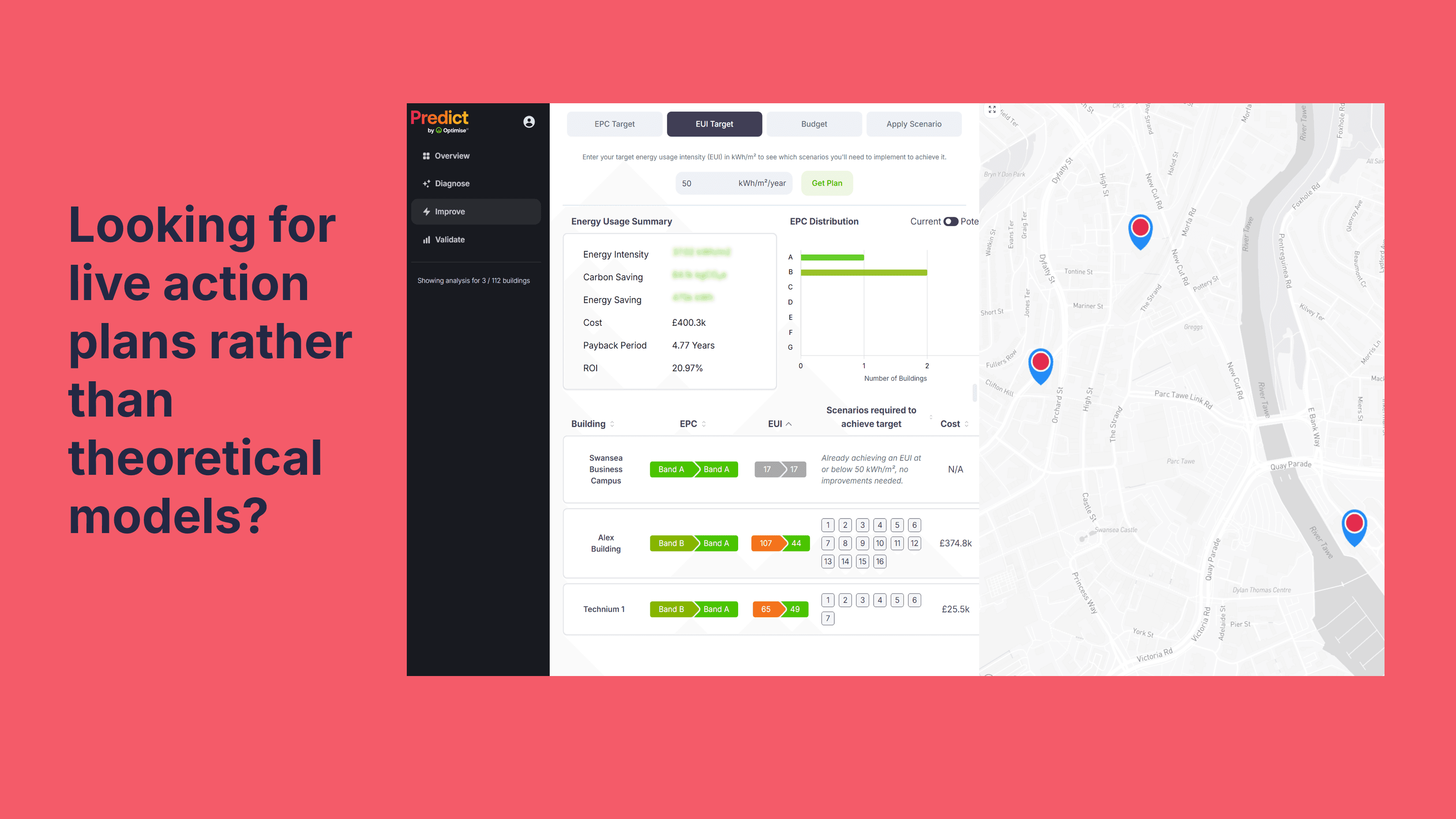
Estate View changes the game by aggregating everything into a unified, actionable view. As a building energy management system, it works across your entire UK estate, whether that's three sites or three hundred. We categorise the estate into structured levels of detail:
Tier 1 buildings may only have a smart meter
Tier 2 buildings may have additional submeters to understand different zones or floors
Tier 3 is deep, smart building energy optimisation using BIM, BMS, and IoT data
It means that if you operate dozens of properties, you don't need deep optimisation on all of them. You might optimise four modern buildings with BMS and IoT data, then apply a simpler logic that can use as little as a smart meter for the other forty-two.
For Sustainability Leaders, this solves the "analysis paralysis" of capital expenditure. Instead of a generic recommendation, our AI building energy management platform lets you run estate-wide simulations: "What happens to our carbon footprint and budget if we install heat pumps across these ten specific sites?" It translates the abstract ideal of Net Zero into real numbers, actual costs saved, carbon tonnes averted and verified returns on investment.
And for day-to-day Estate Managers, it solves the trust problem. An automation tool is only as good as the integrity of the data it feeds on. By bringing your entire portfolio into one view, it encourages data owners to look closely, verify their streams, and clean up the legacy inaccuracies that have been buried in desktop folders for years.
For Large Building Developers navigating the demands of compliance frameworks like CF25 and MEES compliance, the value is entirely different. They aren't looking at long-term energy strategy; they are buried under the logistical nightmare of construction handover. Different contractors, different naming taxonomies, completely different formatting, and messy data streams. Estate View cuts right through this noise. It standardises the data at handover and allows developers to generate exact, compliant exports with the press of a button.
The Realities of Launching a New Solution
The reaction from our early testers has given us some real "wow" moments. During a demo with a technical lead from Deloitte recently, she openly admitted she was "freaking out, this is amazing" watching the estate simulations run in real time.
Another technical sales leader from the legacy digital twin space looked at what we've built and asked, "Why is everyone not using this yet?" He pointed out that old digital twins were solutions looking for a problem. What we have built here is a direct, practical answer to a compliance and commercial nightmare.
"Legacy digital twins were software products looking for a problem. What we've built is a direct, practical answer to a commercial and regulatory nightmare."
How to introduce this change?
But I want to be entirely transparent with you: launching a tool like this highlights a real change management hurdle. Manual reporting has built an entire safety net around teams. People get attached to the Excel files they built and manually update every month. Moving them away from that comfort zone takes real work.
We are also operating in a market where regulatory pressure can sometimes be pushed into the long grass by governments wary of placing extra costs on businesses. Because of that, we have to make the financial return so undeniable, and the operational time savings so clear, that choosing not to use it feels like a deliberate business penalty. We believe that's what we've achieved.
As net zero buildings software built specifically for the complexity of UK estates, OptimiseAI is designed to scale with you. We're a lean, fast-moving team. If an estate partner asks us for a specific dashboard pivot, we often build it and have it live within 24 hours. That speed is our superpower, and with Estate View, we are finally bringing that agility to the macro-scale.
Click here for a 20 minute conversation on how this might be applied to your estate.
Chat to us
Copyright ©
2026
optimise-ai.com
Back to Blog
Why We Built Estate View
When we started OptimiseAI, we were incredibly focused on mastering the single building. We thought if we could look at one complex asset, inject the right data streams, and build highly accurate simulations, we would solve the problem. But over the last few months, our customers have quietly, and sometimes loudly, schooled us on a much larger reality.
Multiple buildings, and certainly large estates, are now too complicated to manage with traditional methods.
Sustainability leaders of massive estates don't have the luxury of obsessing over just one property. They manage 10, 50, or hundreds of disparate spaces. Managing an estate through a series of fragmented, single-building dashboards is impossible. And for organisations trying to genuinely decarbonise their building portfolio it’s unsustainable.
That is why we built our new Estate View.
We didn't build it because it was a neat technical milestone. We built it because partners like ScotRail came to us trying to chart a path to net zero across an entire network of stations. We built it because St Andrews University and Lloyds looked at their vast footprints and asked a fundamental question:
"With limited budgets and mounting pressure, where do we actually spend the next pound to make the biggest impact?"
What Estate View Actually Solves
For years, the status quo in commercial building energy management has been driven by a cottage industry of manual reporting: endless, fragmented spreadsheets, Word documents, and consultants trying to stitch together legacy data points.
"The incumbent in our industry isn't another software company. It's Excel sheets, Word documents, and thousands of hours spent guessing."
Estate View changes the game by aggregating everything into a unified, actionable view. As a building energy management system, it works across your entire UK estate, whether that's three sites or three hundred. We categorise the estate into structured levels of detail:
Tier 1 buildings may only have a smart meter
Tier 2 buildings may have additional submeters to understand different zones or floors
Tier 3 is deep, smart building energy optimisation using BIM, BMS, and IoT data
It means that if you operate dozens of properties, you don't need deep optimisation on all of them. You might optimise four modern buildings with BMS and IoT data, then apply a simpler logic that can use as little as a smart meter for the other forty-two.
For Sustainability Leaders, this solves the "analysis paralysis" of capital expenditure. Instead of a generic recommendation, our AI building energy management platform lets you run estate-wide simulations: "What happens to our carbon footprint and budget if we install heat pumps across these ten specific sites?" It translates the abstract ideal of Net Zero into real numbers, actual costs saved, carbon tonnes averted and verified returns on investment.
And for day-to-day Estate Managers, it solves the trust problem. An automation tool is only as good as the integrity of the data it feeds on. By bringing your entire portfolio into one view, it encourages data owners to look closely, verify their streams, and clean up the legacy inaccuracies that have been buried in desktop folders for years.
For Large Building Developers navigating the demands of compliance frameworks like CF25 and MEES compliance, the value is entirely different. They aren't looking at long-term energy strategy; they are buried under the logistical nightmare of construction handover. Different contractors, different naming taxonomies, completely different formatting, and messy data streams. Estate View cuts right through this noise. It standardises the data at handover and allows developers to generate exact, compliant exports with the press of a button.
The Realities of Launching a New Solution
The reaction from our early testers has given us some real "wow" moments. During a demo with a technical lead from Deloitte recently, she openly admitted she was "freaking out, this is amazing" watching the estate simulations run in real time.
Another technical sales leader from the legacy digital twin space looked at what we've built and asked, "Why is everyone not using this yet?" He pointed out that old digital twins were solutions looking for a problem. What we have built here is a direct, practical answer to a compliance and commercial nightmare.
"Legacy digital twins were software products looking for a problem. What we've built is a direct, practical answer to a commercial and regulatory nightmare."
How to introduce this change?
But I want to be entirely transparent with you: launching a tool like this highlights a real change management hurdle. Manual reporting has built an entire safety net around teams. People get attached to the Excel files they built and manually update every month. Moving them away from that comfort zone takes real work.
We are also operating in a market where regulatory pressure can sometimes be pushed into the long grass by governments wary of placing extra costs on businesses. Because of that, we have to make the financial return so undeniable, and the operational time savings so clear, that choosing not to use it feels like a deliberate business penalty. We believe that's what we've achieved.
As net zero buildings software built specifically for the complexity of UK estates, OptimiseAI is designed to scale with you. We're a lean, fast-moving team. If an estate partner asks us for a specific dashboard pivot, we often build it and have it live within 24 hours. That speed is our superpower, and with Estate View, we are finally bringing that agility to the macro-scale.
Click here for a 20 minute conversation on how this might be applied to your estate.
Back to Blog
Want to be the first to test this?
We are looking for early stage partners who are willing to test across their estates.
Book a time to discuss
Copyright ©
2026
optimise-ai.com
Back to Blog
Why We Built Estate View
When we started OptimiseAI, we were incredibly focused on mastering the single building. We thought if we could look at one complex asset, inject the right data streams, and build highly accurate simulations, we would solve the problem. But over the last few months, our customers have quietly, and sometimes loudly, schooled us on a much larger reality.
Multiple buildings, and certainly large estates, are now too complicated to manage with traditional methods.
Sustainability leaders of massive estates don't have the luxury of obsessing over just one property. They manage 10, 50, or hundreds of disparate spaces. Managing an estate through a series of fragmented, single-building dashboards is impossible. And for organisations trying to genuinely decarbonise their building portfolio it’s unsustainable.
That is why we built our new Estate View.
We didn't build it because it was a neat technical milestone. We built it because partners like ScotRail came to us trying to chart a path to net zero across an entire network of stations. We built it because St Andrews University and Lloyds looked at their vast footprints and asked a fundamental question:
"With limited budgets and mounting pressure, where do we actually spend the next pound to make the biggest impact?"
What Estate View Actually Solves
For years, the status quo in commercial building energy management has been driven by a cottage industry of manual reporting: endless, fragmented spreadsheets, Word documents, and consultants trying to stitch together legacy data points.
"The incumbent in our industry isn't another software company. It's Excel sheets, Word documents, and thousands of hours spent guessing."
Estate View changes the game by aggregating everything into a unified, actionable view. As a building energy management system, it works across your entire UK estate, whether that's three sites or three hundred. We categorise the estate into structured levels of detail:
Tier 1 buildings may only have a smart meter
Tier 2 buildings may have additional submeters to understand different zones or floors
Tier 3 is deep, smart building energy optimisation using BIM, BMS, and IoT data
It means that if you operate dozens of properties, you don't need deep optimisation on all of them. You might optimise four modern buildings with BMS and IoT data, then apply a simpler logic that can use as little as a smart meter for the other forty-two.
For Sustainability Leaders, this solves the "analysis paralysis" of capital expenditure. Instead of a generic recommendation, our AI building energy management platform lets you run estate-wide simulations: "What happens to our carbon footprint and budget if we install heat pumps across these ten specific sites?" It translates the abstract ideal of Net Zero into real numbers, actual costs saved, carbon tonnes averted and verified returns on investment.
And for day-to-day Estate Managers, it solves the trust problem. An automation tool is only as good as the integrity of the data it feeds on. By bringing your entire portfolio into one view, it encourages data owners to look closely, verify their streams, and clean up the legacy inaccuracies that have been buried in desktop folders for years.
For Large Building Developers navigating the demands of compliance frameworks like CF25 and MEES compliance, the value is entirely different. They aren't looking at long-term energy strategy; they are buried under the logistical nightmare of construction handover. Different contractors, different naming taxonomies, completely different formatting, and messy data streams. Estate View cuts right through this noise. It standardises the data at handover and allows developers to generate exact, compliant exports with the press of a button.
The Realities of Launching a New Solution
The reaction from our early testers has given us some real "wow" moments. During a demo with a technical lead from Deloitte recently, she openly admitted she was "freaking out, this is amazing" watching the estate simulations run in real time.
Another technical sales leader from the legacy digital twin space looked at what we've built and asked, "Why is everyone not using this yet?" He pointed out that old digital twins were solutions looking for a problem. What we have built here is a direct, practical answer to a compliance and commercial nightmare.
"Legacy digital twins were software products looking for a problem. What we've built is a direct, practical answer to a commercial and regulatory nightmare."
How to introduce this change?
But I want to be entirely transparent with you: launching a tool like this highlights a real change management hurdle. Manual reporting has built an entire safety net around teams. People get attached to the Excel files they built and manually update every month. Moving them away from that comfort zone takes real work.
We are also operating in a market where regulatory pressure can sometimes be pushed into the long grass by governments wary of placing extra costs on businesses. Because of that, we have to make the financial return so undeniable, and the operational time savings so clear, that choosing not to use it feels like a deliberate business penalty. We believe that's what we've achieved.
As net zero buildings software built specifically for the complexity of UK estates, OptimiseAI is designed to scale with you. We're a lean, fast-moving team. If an estate partner asks us for a specific dashboard pivot, we often build it and have it live within 24 hours. That speed is our superpower, and with Estate View, we are finally bringing that agility to the macro-scale.
Click here for a 20 minute conversation on how this might be applied to your estate.
Back to Blog
Want to be the first to test this?
We are looking for early stage partners who are willing to test across their estates.
Book a time to discuss
Copyright ©
2026
optimise-ai.com